


Baoji Ruihenghua Titanium Metal Composite New Materials Co., Ltd. is one of the leading manufacturers and suppliers of lead alloy anode plate in China. If you're going to buy customized lead alloy anode plate made in China, welcome to get more information from our factory. For price consultation, contact us.
Product Overview
Our factory manufactures lead alloy anode plates using an integrated hot-rolling and cold-rolling process. The primary model features a Pb-Ca-Sn ternary alloy, with traditional Pb-Sb binary alloys available upon request. The standard composition-Pb ≥ 99.5%, Ca 0.06–0.13%, and Sn 0.07–0.1%-fully complies with the ASTM B29 industrial standard for lead alloys. Each anode is laser-welded to an ETP (Electrolytic Tough Pitch) pure copper busbar, ensuring excellent overall electrical conductivity and uniform current distribution across the plate surface.
Unlike titanium-based DSA anodes (such as Ru-Ti, Ir-Ta, PbO₂, Pt-plated, or MnO₂ types), these lead-alloy anodes consist entirely of a metal alloy substrate-without titanium bases or precious metal coatings. Their low initial procurement cost makes them the most economical choice for large-scale applications, such as processing acidic etching waste from PCB manufacturing and copper electrowinning in hydrometallurgy. During operation in acidic sulfate or low-chloride copper chloride electrolytes, a dense β-PbO₂ passivation layer spontaneously forms on the plate surface; this stabilizes the oxygen evolution reaction and inhibits rapid anode corrosion.
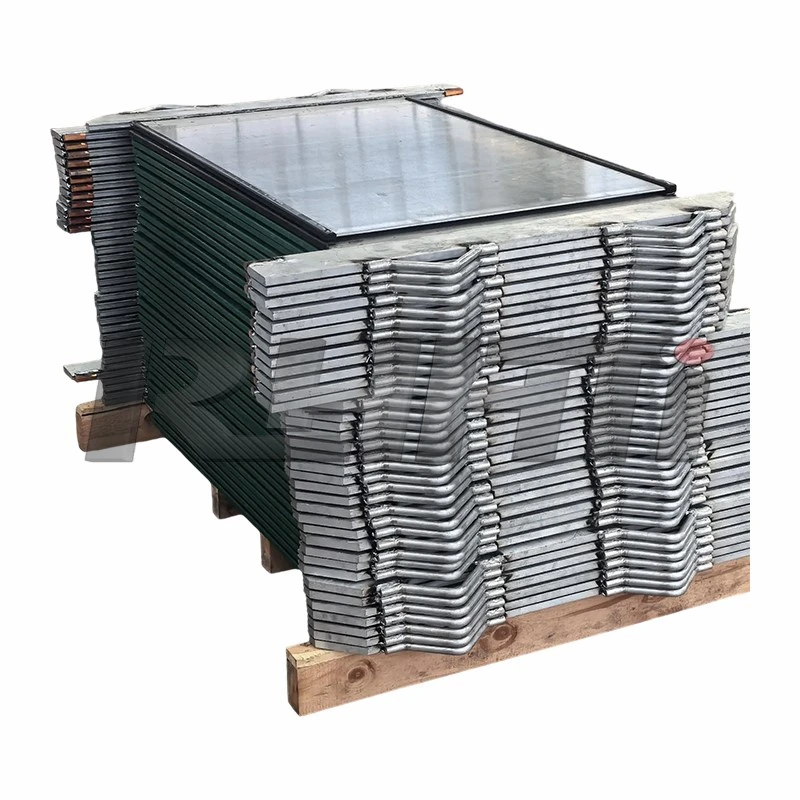
Product Limitations: During prolonged electrolysis, trace amounts of lead ions dissolve into the electrolyte, slightly reducing cathode copper purity. Additionally, the plate gradually thins with continuous use, altering the anode-to-cathode spacing; consequently, these anodes are unsuitable for high-purity/high-precision copper recovery or precision PCB electroplating lines. Under continuous acidic waste treatment conditions (24-hour operation at low-to-medium current), the stable service life is 4–6 years. Once scrapped due to corrosion, the entire plate can be remelted, allowing for 100% material recycling.
We offer full customization of dimensions, plate thickness, copper busbar specifications, and surface perforation patterns for flow optimization. With over a decade of experience in the R&D and manufacturing of rolled lead-alloy anodes, we supply large-scale PCB waste regeneration plants, hydrometallurgical facilities (copper, cobalt, nickel), and industrial wastewater oxidation treatment enterprises worldwide.
Product Parameters
|
Parameter Item |
International Standard Specifications |
| Common Alloy Grades |
Pb-Ca-Sn ternary alloy (standard); Pb-Sb binary alloy (custom) |
| Alloy Chemical Composition |
Pb ≥99.5%; Ca: 0.06–0.13%; Sn: 0.07–0.1% |
| Standards |
ASTM B29 (Standard Specification for Rolled Lead Alloys); HG/T2471-2007 (Electrode Industry Standard) |
| Customizable Plate Thickness | 6mm / 8mm / 10mm / 12mm |
| Busbar Configuration |
ETP (Electrolytic Tough Pitch) copper busbar; seamless laser welding |
| Compatible Waste Streams |
Low-chloride PCB acidic cupric chloride etching waste; sulfate-based copper/cobalt/nickel electrowinning solutions; acidic industrial oxidative wastewater |
| Operating Current Density |
100–500 A/m² (stable low-to-medium current load) |
| Continuous Operating Temperature |
40–60°C |
| Operating PH Range |
0.5–4 (suitable for strong acid systems only; not for alkaline baths) |
| Rated Service Life |
4–6 years (based on continuous 24-hour electrolysis) |
| Optional Plate Structure |
Solid flat plate; perforated flow-directing plate (enhances electrolyte circulation) |
| Cathode Copper Purity |
≥99.9% (contains trace lead ion impurities) |
| Key Unique Features |
Very low initial procurement cost; fully recyclable materials; acid corrosion resistance; cost-effective electrode for large-scale waste treatment |
| Compatible Cathodes |
Pure copper cathode plates; stainless steel cathode plates |
Core Product Advantages
Extremely low initial equipment investment; the top choice for cost-effective large-scale waste treatment. Eliminates the need for titanium substrates and precious metal plating/sintering processes; raw material and processing costs are far lower than those of all titanium-based DSA anodes (Ru-Ti, Ir-Ta, PbO₂, Pt-plated, MnO₂). For large PCB factories processing thousands of cubic meters of etching waste daily, selecting lead alloy anodes significantly reduces upfront capital expenditure on equipment and shortens the investment payback period. 2. 100% Material Recyclability at End-of-Life: Once the anode reaches the end of its service life due to thinning from long-term corrosion, the entire lead-alloy unit can be sent to a smelter for remelting and re-rolling into brand-new anode plates. This process leaves no solid waste residue and achieves a material recovery rate of nearly 100%. Compared to disposable titanium anodes-which become worthless once their coating is depleted and cannot be recoated-this product offers a lower total material cost over its entire lifecycle.
Application Scenarios
This Lead Alloy Anode Plate is a traditional, cost-effective, high-flow inert electrode designed for closed-loop copper recovery from large-scale PCB acidic etching waste solutions. It is widely used in high-flow, low-purity hydrometallurgical electrolysis processes, such as copper extraction from low-chloride acidic cupric chloride etching waste, sulfate-based copper/cobalt/nickel electrowinning, and the oxidative degradation of organic matter in acidic industrial wastewater. When paired with pure copper or stainless steel cathode plates, it forms a complete, low-cost electrolytic copper recovery system that produces industrial-grade cathode copper while regenerating the acidic etching solution, thereby significantly reducing the total equipment investment for large-scale PCB manufacturing plants.
Product Details
Integrated Hot-Rolling And Cold-Rolling Process
Hot-rolling eliminates internal casting defects, followed by precision cold-rolling to control plate thickness within a ±0.2mm tolerance, ensuring a flat surface free of pits, cracks, or burrs. Perforated structures can be customized to enhance electrolyte circulation and minimize gas bubble accumulation on the plate surface, which would otherwise impair electrical conductivity.
Comprehensive Factory Inspection
Each lead-alloy anode undergoes rigorous testing, including spectral analysis of alloy composition, tensile strength testing of the copper busbar weld, surface flatness verification, and dimensional tolerance calibration. All specifications fully comply with global industry standards for copper electrowinning from large-scale PCB acidic waste solutions.
Product Qualifications
Our factory specializes in the production of standard rolled Pb-Ca-Sn alloy anodes. We hold complete production qualifications and operate an independent laboratory for spectral analysis of alloy composition. All lead-alloy anodes designed for PCB etchant recovery are manufactured in compliance with ASTM B29 non-ferrous alloy standards and the domestic HG/T2471-2007 industry standard for electrodes; they support authoritative third-party material composition testing (e.g., SGS). We provide comprehensive alloy spectral analysis reports, weld strength test documentation, and full factory qualification records. The products meet EU REACH standards for industrial heavy metal control and are suitable for procurement by large-scale global electronic waste recycling and hydrometallurgical plants.
Logistics and After-Sales Service
Packaging And Shipping
Packaging consists of solid wood pallets with waterproof and impact-resistant plastic film wrapping; copper busbars are wrapped in anti-oxidation protective film, making them suitable for long-distance ocean freight. Ample stock is available for standard specifications, with delivery in 5–7 working days; expedited production is available for custom orders regarding plate thickness, dimensions, perforation patterns, and busbar specifications. We offer comprehensive global logistics coverage via sea, air, and bulk freight, ensuring reliable delivery.
After-Sales Support
One-stop free pre-sales technical consultation: matching acidic etching waste parameters (chloride ion concentration and pH) with operating conditions, selecting lead alloy grades, OEM customization of anode dimensions, and guidance on matching cathodes for electrolytic cells. We provide recycling, remelting, and refurbishment services for spent lead anodes. Free replacements are provided for verified manufacturing or welding defects, ensuring zero-risk procurement for large-scale global PCB and hydrometallurgy operations.
Frequently Asked Questions
Q1: What are the key differences between lead-alloy anodes and various titanium-based DSA anodes (Ru-Ti, Ir-Ta, PbO₂, Pt-plated, MnO₂) in PCB copper recovery applications?
A1: Lead-alloy anodes have very low raw material costs, and spent lead plates are 100% recyclable; they are suitable for high-flow, low-chloride acidic waste streams where copper purity requirements are not stringent. Drawbacks include continuous lead ion dissolution contaminating the electrolyte, gradual shrinkage of plate dimensions over time, higher cell voltage and power consumption, and unsuitability for high-precision PCB electroplating lines. Titanium-based DSA anodes offer dimensional stability, a non-dissolving substrate, and high-purity copper output with lower energy consumption; while the initial purchase price is higher, the substrates can be returned to the factory for recoating and reuse after the original coating fails.
Q2: Can anode dimensions, thickness, and perforation patterns be customized?
A2: Yes, we support full-scope OEM customization. We can adjust anode length and width, plate thickness, aperture size and spacing, as well as the cross-section and welding position of the copper busbar, to match the internal dimensions of the customer's electrolytic cells.
Company Updates
For over a decade, our factory has specialized in the production of standard rolled Pb-Ca-Sn alloy anodes designed for large-scale PCB acidic etching waste recovery and hydrometallurgical electrowinning. We continuously optimize our hot- and cold-rolling forming and alloy smelting processes to enhance surface flatness and corrosion resistance while minimizing the lead dissolution rate. Our products are widely exported to major PCB waste recovery and metal smelting facilities across Southeast Asia, Europe, and the Americas, and we have established long-term, stable strategic partnerships with dozens of regional industrial groups.
Hot Tags: lead alloy anode plate, China lead alloy anode plate manufacturers, suppliers, factory, Lead Alloy Anode Plate, lead based anode plates