

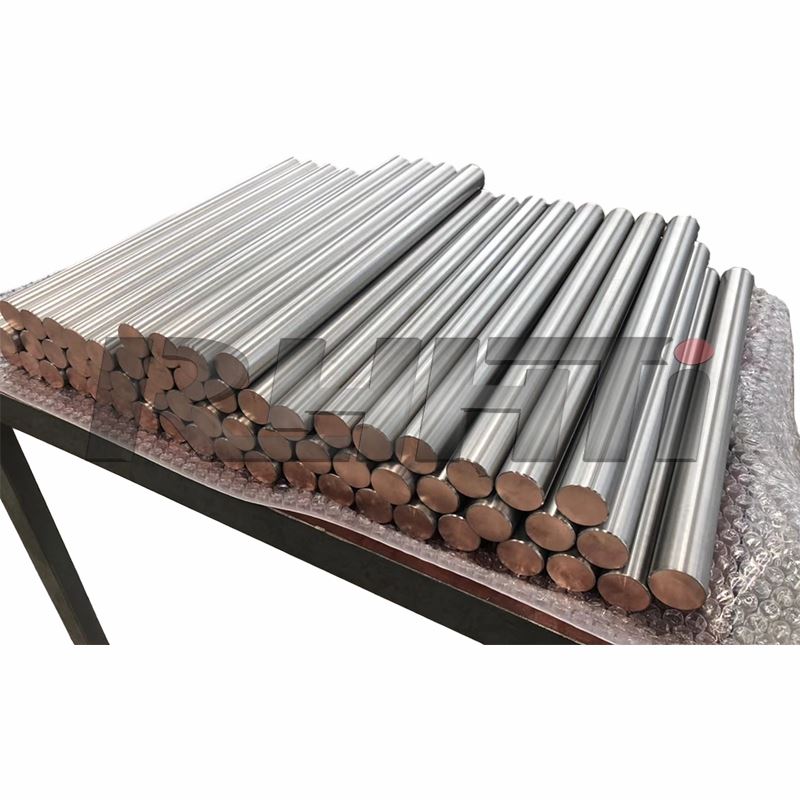


Baoji Ruihenghua Titanium Metal Composite New Materials Co., Ltd. is one of the leading manufacturers and suppliers of nickel plated copper in China. If you're going to buy customized nickel plated copper made in China, welcome to get more information from our factory. For price consultation, contact us.
Product Introduction
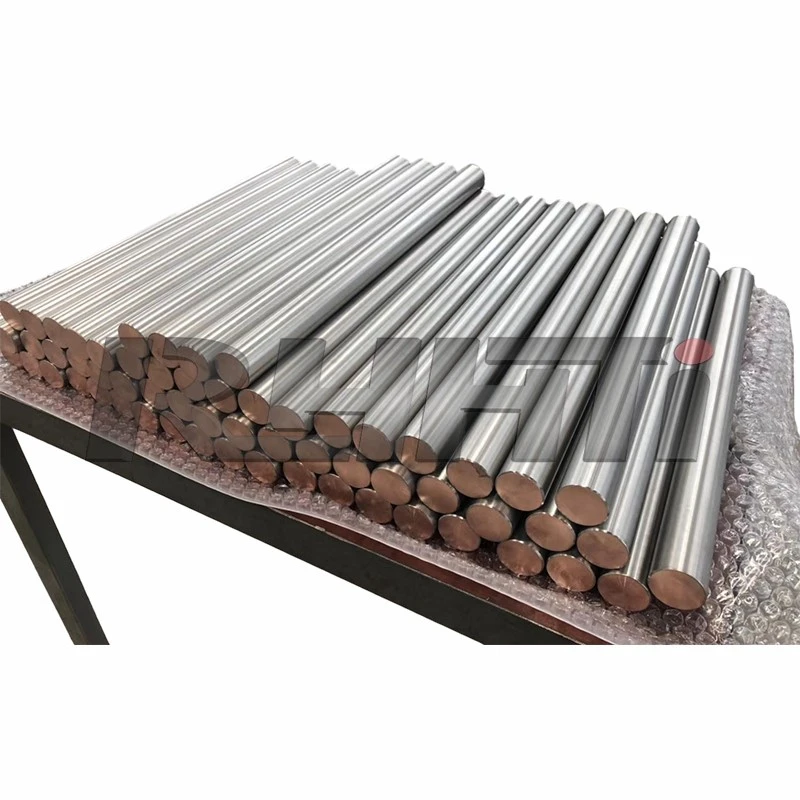
Nickel plated copper (nickel-copper clad rod/conductive electrode) is a high-performance bimetallic composite material prepared using explosive bonding and precision drawing/rolling processes. High-purity nickel is uniformly coated on the outer layer of a copper rod matrix, achieving a 360° circumferential gapless metallurgical bond. The product combines the excellent resistance to concentrated alkalis, wear, and high-temperature oxidation of pure nickel with the extremely high electrical and thermal conductivity of copper. The outer nickel layer isolates corrosive media and provides wear-resistant protection, while the inner copper core ensures high-current, low-resistance conduction and efficient heat dissipation. Compared to pure nickel rods, nickel-clad copper reduces material costs by 50%-70% while maintaining identical corrosion and wear resistance at the contact surface. Simultaneously, it significantly improves overall conductivity and heat dissipation, solving the industry pain points of poor conductivity, high cost, and overheating under high-current conditions associated with pure nickel. It is widely used as electroplating anodes, alkaline electrolytic conductive components, wear-resistant conductive rollers, electronic connectors, and marine corrosion-resistant conductive components, making it a cost-effective core material for alkali-resistant, wear-resistant, and conductive applications.
Product Parameter
Implement International Standards System
● Nickel cladding material standard: ASTM B162 (Standard specification for nickel and nickel alloy sheets and bars).
● Copper matrix material standard: ASTM B187 (Standard specification for copper and copper alloy bars and profiles).
● Composite processes and testing: Specifications for explosive welding of dissimilar metals, standards for ultrasonic flaw detection.
● Acceptance and quality assurance standards: EN 10204 3.1 Original manufacturer's material certificate.
Standard Material Grade
|
Layered Structure |
Optional International Brands |
Operating Condition Adaptation Instructions |
|
Nickel protective outer layer |
Ni200 industrial pure nickel, Ni201 low-carbon pure nickel |
Ni200: Suitable for general-purpose applications involving alkaline corrosion and wear resistance at room and medium temperatures; Ni201: Low-carbon, high-purity, resistant to intergranular corrosion in high-temperature, concentrated alkaline conditions. |
|
Copper conductive core layer |
C11000 ETP copper, C10200 OFHC oxygen-free copper |
C11000: General-purpose conductive material; C10200: High-purity, low-impedance, for precision electronics/high-end electrolysis. |
Product Features and Applications
Product Advantages
It features a full-circumferential atomic-level metallurgical bond with a dense and uniform interface, unlike the mechanical adhesion of electroplating and electroless plating. It has no risk of blistering, peeling, or detachment during long-term use and can withstand deep processing such as drawing, bending, and turning.
The outer nickel material has extremely strong corrosion resistance to strong alkaline media such as high-temperature concentrated sodium hydroxide and potassium hydroxide, and also has excellent wear resistance and high-temperature oxidation resistance, which can meet the requirements of both corrosion and wear conditions at the same time.
The copper core layer ensures extremely low conductivity and efficient heat dissipation, solving the problems of poor conductivity and easy overheating under high current conditions of pure nickel electrodes, resulting in more stable equipment operation and lower energy consumption.
Only the outer functional layer uses nickel, while the interior uses highly conductive copper. Compared with pure nickel rods, it saves 50%–70% of material costs while providing the same corrosion resistance and wear resistance, significantly reducing equipment procurement and maintenance costs.
It supports secondary processing such as centerless grinding, turning, drilling, welding, and surface plating, with high dimensional accuracy and controllable surface condition, and can be directly processed into finished conductive components for delivery.
Application Areas
Electroplating industry: insoluble electroplating anodes, conductive rollers for electroplating production lines, conductive rods for hangers, and precious metal electroplating electrodes.
Chlor-alkali chemical industry: conductive components for ion-exchange membrane electrolyzers, conductive rods for caustic soda evaporation equipment, and alkaline electrolyte conveying components.
Electronics industry: connector substrate, lead frame material, conductive pins of precision electronic components.
Metallurgical industry: Electrolytic refining conductive rods, electrodes for alkaline systems in hydrometallurgy, and conductive components for molten salt electrolysis.
Marine engineering: conductive connectors for seawater environments, auxiliary anodes for impressed current cathodic protection, and seawater corrosion-resistant conductive components.
Heat treatment: conductive electrodes for high-temperature furnaces, conductive lead-out rods for vacuum equipment, and wear-resistant conductive parts for high-temperature applications.
Product Details
Outer nickel surface
Default bright finish, optional fine grinding, polishing, wire drawing, passivation treatment to suit different working conditions.
01
End face treatment
Default is flat cut, but chamfering and nickel cap sealing can be performed to prevent the copper layer on the end face from being exposed to corrosive media.
02
Straightness
Standard grade ≤1.0mm/m, Precision grade ≤0.5mm/m.
03
Optional advanced processing services
We support customized end processing according to drawings, drilling and tapping, welding of terminals, forming of irregular electrodes, and nickel layer sealing of end faces, and provide guidance on nickel-copper dissimilar metal welding processes.
04
Product Supporting Documents
Authoritative International Qualification Certificates
ASTM B162 and ASTM B187 material testing reports, and original manufacturer material certificates in EN 10204 3.1 for each batch.
ISO 9001 Quality Management System Certification, ISO 14001 Environmental Management System Certification.
Third-party SGS test report on interface bonding strength, alkali corrosion resistance, and conductivity.
Testing qualifications for materials used in the electroplating and electronics industries.
thoughtful service
Packaging Standards (For Export By Sea)
Each product is individually wrapped with a PE protective film and pearl cotton, and a plastic protective cap is added to the end.
The entire batch was packed into fumigated solid wood export crates, with the interior filled with shock-absorbing foam and moisture-proof desiccant.
The wooden crates are labeled with material grade, specifications, number of pieces, gross weight, and moisture-proof/lifting markings, suitable for all scenarios including sea, land, and air transport.
Professional Consultation Q&A
Q1: What are the main differences between nickel-plated copper rods and electroplated nickel-copper rods?
A1: Electroplated nickel forms only a thin mechanical coating on the copper surface with weak adhesion. It is prone to blistering, peeling, and wear under friction, bending, and corrosive conditions, and the nickel layer thickness is typically only a few micrometers. Our nickel-clad copper rods utilize explosive welding to achieve atomic-level metallurgical bonding, with a bonding strength ≥120MPa. They do not delaminate after bending and stretching, and the nickel layer thickness can reach several millimeters. This results in a longer service life and makes them suitable for heavy-duty, highly corrosive, and long-term operating environments.
Q2: What corrosive media is nickel-plated copper primarily suitable for? What are its limitations?
A2: Nickel-plated copper exhibits excellent corrosion resistance to strong alkalis (NaOH, KOH), neutral salt solutions, organic acids, and atmospheric environments, and also demonstrates good high-temperature oxidation resistance. However, it is not recommended for use in environments with strong oxidizing acids (such as concentrated nitric acid) or high concentrations of sulfides. For strongly acidic environments, we recommend using tantalum-plated copper or zirconium-plated copper products.
Q3: How to select the appropriate nickel plating thickness according to different working conditions?
A3: For conventional electroplating and atmospheric corrosion protection, a 0.3–0.8 mm Ni200 nickel plating layer is sufficient for long-term use. For high-temperature, concentrated alkali, and wear-resistant conductive roller applications, a 1.5–3 mm nickel plating layer is recommended to allow for sufficient corrosion and wear tolerances. We can provide accurate recommendations based on your specific medium concentration, temperature, and friction frequency parameters.
Latest company news
Ruihenghua Titanium upgraded its cladding rod production line, achieving standardized mass production of tantalum-clad copper and nickel-clad copper series.
Baoji Ruiheng Huatai Titanium Metal Composite New Materials Co., Ltd., located in Baoji City, China's "Titanium Valley," has completed the upgrade and transformation of its radial explosive welding and precision drawing production line for bimetallic clad rods, further expanding its mass production capacity for high-end conductive composite materials such as tantalum-clad copper and nickel-clad copper. With 20 years of experience in non-ferrous metal processing, the company is equipped with electron beam melting furnaces, vacuum annealing furnaces, and a complete set of precision machining equipment, mastering the entire process technology from composite material billet preparation to finished product deep processing. This production line adopts an integrated process of explosive welding billets and multi-stage precision drawing, equipped with an online wall thickness monitoring system, enabling 360° all-round metallurgical bonding, with radial wall thickness deviation controlled within ±0.05mm. Currently, the company can provide a full range of products from φ0.3mm fine wires to φ200mm large-diameter composite rods, with applications covering semiconductor etching, precious metal hydrometallurgy, high-end electroplating anodes, and chlor-alkali conductive components. The delivery cycle for customized products has been effectively shortened to 15-20 days, providing stable supply guarantees for high-end manufacturing and fine chemical customers worldwide.
Applications of tantalum-clad copper and nickel-clad copper electrodes in domestic hydrometallurgical and high-end electroplating projects.
Recently, our company's R05200 high-purity tantalum-clad copper electrolytic electrodes and Ni201 nickel-clad copper anode rods have been successfully applied in domestic precious metal hydrometallurgy and high-end hardware electroplating production lines, respectively, and have passed long-term field operation verification. The tantalum-clad copper electrode uses 99.95% high-purity tantalum coating and can operate stably for a long time in concentrated hydrochloric acid and mixed acid systems, with a service life more than three times that of traditional titanium electrodes. The nickel-clad copper anode rod has excellent alkali resistance and wear resistance, with a copper core conductivity ≥97% IACS, solving industry pain points such as low conductivity and easy overheating of pure nickel anodes. Field data shows that these two products can help customers reduce the overall cost of electrode materials by more than 40% while ensuring stable process performance.
Upgraded high-end coated conductor customization service, supporting one-stop customization solutions.
To meet the diverse needs of global semiconductor, electroplating, and metallurgical industry customers, our company has comprehensively upgraded its customized service system for tantalum-clad copper and nickel-clad copper products. We provide full-cycle technical support, from material grade selection and cladding thickness design to irregular shape processing and end-face sealing welding. We can also customize finished components such as irregularly shaped electrodes, conductive terminals, and transition connectors according to customer drawings. Each batch of products can be issued with an EN 10204 3.1 factory test certificate and supports third-party testing such as SGS. The company has independent import and export qualifications and has established a complete global supply and service system covering Europe, Southeast Asia, North America, and other regions, committed to providing high-performance bimetallic composite conductive solutions for high-end manufacturing customers worldwide.
Hot Tags: nickel plated copper, China nickel plated copper manufacturers, suppliers, factory, Anode For Water Electrolysis, bimetallic coated metal materials, Cathode Flying Target For PCB, Nickel Plated Copper, other metal composite conductive rods, Tantalum Clad Copper