


Baoji Ruihenghua Titanium Metal Composite New Materials Co., Ltd. is one of the leading manufacturers and suppliers of cathode flying target for pcb in China. If you're going to buy customized cathode flying target for pcb made in China, welcome to get more information from our factory. For price consultation, contact us.
Product Introduction
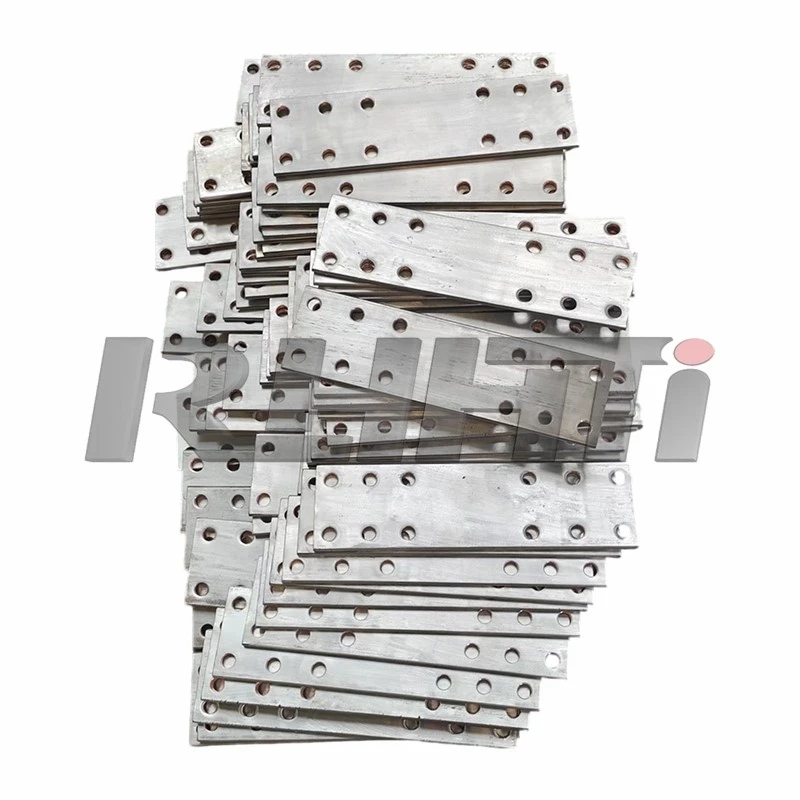
The titanium-clad copper cathode flying target for PCBs is a core conductive and load-bearing component in vertical PCB electroplating production lines. It bears the high-current transmission between the electroplating busbar and the PCB fixtures, while also supporting the total weight of the circuit board and fixtures. The product uses T2 pure copper as its internal conductive core, with the entire outer surface coated with TA2 industrial pure titanium. This metallurgical composite process achieves a seamless integration of the two metals, resulting in excellent conductivity and strong corrosion resistance. Unlike traditional pure copper or stainless steel flying targets, this composite structure avoids the problems of rapid corrosion of copper in acidic plating solutions and copper ion contamination of the plating solution. It also maintains conductivity far exceeding that of pure titanium flying targets, ensuring uniform current distribution across the entire plating width, effectively reducing voltage drop and power consumption. Its service life is 3-5 times that of pure copper flying targets. It is widely used in precision electroplating processes such as through-hole copper plating, pattern plating, and tin plating on PCBs, and is an upgraded core component for high-quality PCB electroplating lines.
Product Parameter
Implement International Standards System
● Composite material standards: ASTM B898 "Standard Specification for Active Metal Composites", GB/T 8547 "Titanium-Steel Composites" (derived copper composite specification).
● Substrate material standards: ASTM B265 (titanium and titanium alloy plates), ASTM B152 (copper and copper alloy plates), GB/T 5231 Processed copper standard.
● Welding process standard: AWS D10.9 Refractory metal tungsten inert gas welding specification, 99.99% high-purity argon gas double-sided shielded welding.
● Environmental compliance standards: Complies with EU RoHS 2.0 directive, free of lead, cadmium, and harmful heavy metal leaching.
● Acceptance and quality assurance standards: EN 10204 3.1 Original manufacturer's material certificate, interface bond strength test report, and form and position accuracy verification report.
● Applicable operating conditions: Suitable for acidic sulfate copper plating, fluoroborate tin plating, and conventional acidic electroplating systems, with an operating temperature ≤70℃; not suitable for hydrofluoric acid or high-concentration fluoride ion media.
Standard Materials And Structural Parameters
|
Parameter Categories |
Optional Specifications |
Illustrate |
|
Main material |
TA2 pure titanium cladding + T2 copper core |
Universal PCB electroplating solution, balancing conductivity, corrosion resistance, and cleanliness. |
|
Cross-sectional shape |
Rectangular, flat, chamfered rectangle |
It can fully match the installation dimensions of existing electroplating tank conductive busbars and mounting brackets. |
|
External dimensions |
Length 800–2500mm / Cross-section width 30–120mm / Cross-section thickness 15–60mm |
Full-size customization available upon request, supporting 1:1 replicas of old flying targets. |
|
Titanium layer thickness |
Single-sided: 1.0–3.0 mm; Regular: 1.5–2.0 mm |
For applications requiring strong corrosion and long service life, a thicker titanium layer is recommended. |
|
Strengthen the structure |
No reinforcing core / Built-in carbon steel reinforcing core |
For large-size heavy-duty boards and high current density applications, a reinforced structure is optional. |
|
End structure |
Conductive lap joint, hanger positioning groove, hoisting position, insulating base installation position |
End processing can be customized according to the installation method. |
|
Optional accessories |
Insulating sleeve, hanger positioning block, conductive clamp, corrosion-resistant end cap |
Optional accessories available to adapt to different brands of electroplating line structures. |
Product Features and Applications
Product Advantages
Atomic-level metallurgical bonding ensures stable and attenuated conductivity: Utilizing explosive bonding or hot-rolled diffusion bonding processes, the titanium-copper interface achieves atomic-level metallurgical bonding with a bonding strength ≥100MPa. This eliminates common issues in mechanical and cold-drawn coating structures, such as delamination, loose connections, and contact resistance drift. The conductivity remains stable under long-term high-current and reciprocating lifting and lowering operation, ensuring uniform current distribution throughout the entire target and guaranteeing consistent plating thickness on the PCB board, avoiding plating defects such as thicker edges and thinner centers.
Full titanium layer corrosion-resistant protection, zero impurity contamination of plating solution: The outer surface is fully covered with TA2 industrial pure titanium, which provides a stable passivation film in commonly used PCB plating solutions such as acidic sulfate copper plating and fluoroborate tin plating, with excellent corrosion resistance. It completely eliminates copper ion precipitation and contamination of the plating solution, avoiding quality problems such as plating fogging, pinholes, and reduced adhesion. It is fully compatible with the precision electroplating cleanliness requirements of high-end PCBs, HDI boards, and automotive boards.
High conductivity and low loss, reducing production power consumption: The inner core is made of high-purity T2 copper with a conductivity of ≥98% IACS, which is far superior to that of pure titanium and stainless steel. During high current transmission, the voltage drop loss and Joule heat are small, effectively reducing the power consumption of the 1,000-foot plate. It also reduces parameter fluctuations caused by abnormal temperature rise in the plating bath. Long-term production can significantly save on electricity and temperature control costs, making it a core choice for energy-saving upgrades of electroplating lines.
High precision and rigidity ensure uniform electroplating: After multiple precision straightening and CNC machining processes, the overall flatness is ≤0.3mm/m. The mounting points of the hangers are precisely symmetrical, resulting in high parallelism of the PCB board surface after suspension and uniform electrode spacing. This effectively avoids problems such as excessive plating thickness difference, board surface color difference, and uneven copper thickness in holes caused by uneven current distribution. An optional built-in steel reinforcing core structure can significantly improve bending and load-bearing capacity, ensuring no deformation during long-term operation under heavy-duty large-board conditions.
Long lifespan and low maintenance, resulting in lower overall operating costs: Under normal operating conditions, the service life can reach more than 5 years, which is 3-5 times that of traditional pure copper targets. Routine grinding, rust removal, and replating repair are not required; only simple cleaning is needed, which greatly reduces the frequency of spare parts replacement and downtime for maintenance. At the same time, it avoids defects such as plating pool contamination and board surface particles caused by copper shavings. The overall cost of long-term use is far lower than that of ordinary pure copper and copper-plated targets.
Application Areas
PCB manufacturing: Cathode conductive targets for vertical electroplating lines, through-hole copper plating, pattern electroplating, tin plating, and nickel-gold electroplating.
FPC flexible board: Cathode conductive beam in roll-to-roll continuous electroplating and flexible board rack plating production line.
Semiconductor packaging: high-precision electroplating of conductive components such as packaging substrate electroplating and lead frame electroplating.
Electroplating: Conductive hanging beams for high-speed barrel plating/rack plating production lines for connectors, terminals, and plugs.
Surface treatment: High-precision cathode conductive beams for precision metal electroplating and aerospace component electroplating.
NProduction line upgrade: Upgrade and replacement solutions for the existing electroplating lines that suffer from excessively rapid corrosion of pure copper and stainless steel targets and poor coating uniformity.
Product Details
Interface Standards
Composite interface bonding rate ≥98%, no large unbonded areas, bonding strength ≥100MPa.
01
Geometric Accuracy
Overall straightness ≤ 0.3 mm/m, flatness of conductive contact surface ≤ 0.1 mm, and deviation of hanging point spacing ≤ 0.5 mm.
02
Welding standards
:The matching welding adopts high-purity argon triple protection, the weld is dense without porosity and oxidation, and after welding, it is ground flat and flush with the base material.
03
Surface quality
The titanium layer surface is free of scratches, cracks, and rust. The passivation film is uniform, complete, clean, and free of oil. All edges and corners are chamfered.
04
Product Supporting Documents
Authoritative International Qualification Certificates
ASTM B898 composite material conformity test report, and EN 10204 3.1 original material certificate issued for each batch.
ISO 9001 Quality Management System Certification, ISO 14001 Environmental Management System Certification.
The interface combines third-party SGS test reports on strength, conductivity, corrosion resistance, and material purity.
The RoHS environmental compliance test report shows that it meets the lead-free and cleanliness requirements of the electronics industry.
thoughtful service
Packaging Standards (For Export By Sea)
The product is fully wrapped in pearl cotton and PE protective film, with protective covers added to the conductive contact surfaces and corner protectors added to the edges and corners to prevent damage, scratches, bending and deformation during transportation.
The entire batch is packed into fumigated solid wood export crates, with the inside filled with shock-absorbing foam to secure it and prevent it from shifting , being squeezed and deformed during transportation.
The wooden crates are labeled with the product model, dimensions, quantity, gross weight, and moisture-proof/lifting markings, making them suitable for all scenarios including sea, land, and air transport.
Professional Consultation Q&A
Q1: Why is a titanium-clad copper cathode target used for precision electroplating of PCBs, instead of a pure copper or stainless steel target?
A1: The core reason is that neither pure copper nor stainless steel can simultaneously meet the requirements of high conductivity, strong corrosion resistance, and plating solution cleanliness. Pure copper has excellent conductivity, but it will gradually corrode in acidic plating solutions, resulting in a short lifespan (usually 1-2 years) and the precipitation of copper ions and copper shavings, contaminating the plating solution and causing quality problems such as plating particles, fogging, and uneven thickness. Stainless steel has better corrosion resistance than pure copper, but its conductivity is extremely low, resulting in large voltage drop and high power consumption under high current. Moreover, long-term use will still cause the precipitation of iron and nickel impurities, affecting the plating quality. The titanium-clad copper plating target uses T2 copper as the inner core to ensure high conductivity, and an outer TA2 titanium layer to ensure strong corrosion resistance and cleanliness. Through metallurgical composite, it achieves the advantages of both metals, solving the corrosion and contamination problem of pure copper and avoiding the defects of poor conductivity and high energy consumption of pure stainless steel. It is a high-reliability upgrade solution for precision electroplating of PCBs.
Q2: What impact do the flatness and current uniformity of the target have on the PCB electroplating quality? What level of precision can you achieve?
A2: The straightness and hanging point accuracy of the cathode target directly determine the parallelism and electrode spacing uniformity after the PCB board is suspended, which are key factors affecting the consistency of plating thickness and the uniformity of through-hole copper. If the target is not straight or the hanging point is off-center, it will lead to inconsistent spacing between the board surface and the anode, resulting in uneven current distribution and defects such as excessive difference in plating thickness between the center and corners of the board surface, substandard through-hole copper thickness, and color difference on the board surface, which seriously affect the PCB yield and reliability. Our targets undergo multiple precision straightening processes, with an overall straightness ≤0.3mm/m, and high-end customized models can achieve ≤0.2mm/m. The hanging point spacing deviation is ≤0.5mm, and the flatness of the conductive contact surface is ≤0.1mm, which can fully ensure uniform current distribution across the entire board surface and effectively improve the consistency of plating thickness and product yield.
Q3: Will the composite interface of the titanium-clad copper flying target delaminate due to frequent vertical vibration, affecting its conductivity life?
A3: Titanium-clad copper flying targets manufactured using metallurgical composite processes will not experience delamination issues during normal reciprocating lifting and lowering operations. We employ explosive bonding or hot-rolled diffusion bonding processes to achieve atomic-level metallurgical bonding at the titanium-copper interface, with a bonding strength ≥100MPa and a bonding rate ≥98%. This allows them to withstand thermal cycling, mechanical vibration, long-term loads, and reciprocating motion without exhibiting common problems such as delamination, poor connections, and soaring contact resistance found in mechanically coated or cold-drawn coated structures. Each batch of products undergoes interface bonding strength and ultrasonic flaw detection before leaving the factory, accompanied by corresponding test reports to ensure long-term conductivity stability .
Latest company news
The entire composite material production line has been fully upgraded, with an annual production capacity of 1,350 tons.
Baoji Ruihenghua Titanium Metal Composite New Materials Co., Ltd. is located in Baoji, Shaanxi Province, known as China's Titanium Valley. Following its asset restructuring in 2024, the company has upgraded its entire production line, encompassing explosive lamination, hot rolling lamination, vacuum heat treatment, and precision deep processing. With over 20 years of experience in non-ferrous metal processing, the company has built a complete production chain from ingot smelting, forging, rolling to vacuum heat treatment, equipped with core production equipment such as a 350KW electron beam melting furnace, a 2000T hydraulic press, and a 1500mm vacuum annealing furnace.
The company's products cover titanium-based, copper-based, stainless steel-based, zirconium-based, and multi-layer transition composite plates, composite rods, and composite profiles, as well as deep-processed finished products such as electrolytic conductive beams, cathode rods, electroplating targets, and electrochemical electrodes. The annual production capacity of the full range of composite materials reaches 1,350 tons. All products are manufactured in strict accordance with international standards such as ASTM and ASME, and a full-process quality traceability system has been established, improving production efficiency by 30%. The delivery cycle for standard batch orders can be controlled within 15 days, providing a stable supply guarantee for customers in global hydrometallurgy, electronic electroplating, environmental water treatment, chemical, and new energy industries.
Deep processing capabilities have been fully expanded, enabling integrated supply from raw materials to finished products.
Focusing on market demand in the fields of hydrometallurgy, electronic electroplating, environmental water treatment and new energy materials, the company's independently developed titanium-based cathode plate and conductive component production and processing project officially passed government filing and environmental protection acceptance in October 2025 and is now in full production.
Building upon its existing composite substrates, the company has further expanded its deep-processing capabilities for finished products such as electrolytic conductive beams, stainless steel copper-clad suspension rods, PCB electroplated cathode targets, MMO-coated titanium anodes, and corrosion-resistant conductive structural components, achieving integrated production from composite substrates to finished products. The company continues to increase its investment in the research and development of dissimilar metal composite technologies, providing targeted material matching and structural design solutions for different operating conditions such as strong acids, strong alkalis, high temperatures and pressures, and high-current corrosion, helping customers optimize project costs and improve equipment lifespan and operational stability.
Upgraded global service system, with self-operated import and export rights to achieve full-category export coverage.
The company possesses formal self-operated import and export qualifications and has established a comprehensive global supply and service system, with business covering multiple countries and regions in Europe, Southeast Asia, North America, and the Middle East. The company collaborates with internationally renowned logistics carriers, providing diversified delivery solutions including sea freight, air freight, and China-Europe freight trains, supporting the export of its full range of composite materials, conductive components, and electrochemical electrode products.
Adhering to the quality philosophy of "Quality First, Customer Supreme," the company provides original material certificates (EN 10204 3.1) for each batch of products, and all bulk orders support testing by third-party organizations such as SGS and BV. The company offers free returns and exchanges for quality issues within 7 days of delivery and long-term product warranties. A professional engineering team provides 24-hour online technical support, and the company is committed to becoming a trusted long-term supplier of metal composite materials and refractory metal components for global customers.
Hot Tags: cathode flying target for pcb, China cathode flying target for pcb manufacturers, suppliers, factory, Anode For Water Electrolysis, Cathode Flying Target For PCB, Stainless Steel Clad Copper, Stainless Steel Copper Clad Hanger