

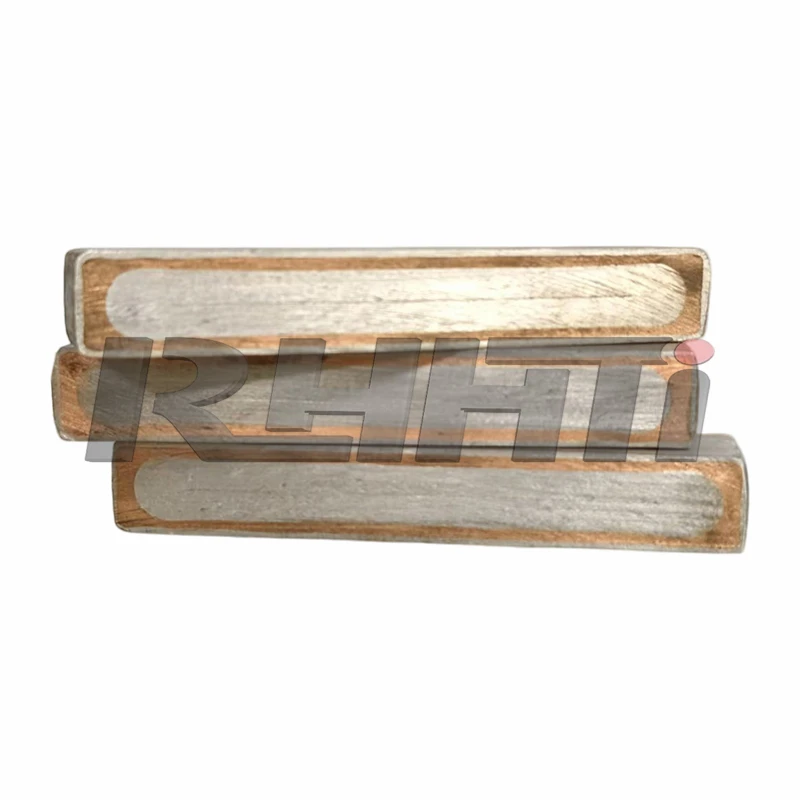


Baoji Ruihenghua Titanium Metal Composite New Materials Co., Ltd. is one of the leading manufacturers and suppliers of nickel plated copper plated steel in China. If you're going to buy customized nickel plated copper plated steel made in China, welcome to get more information from our factory. For price consultation, contact us.
Product Introduction
Nickel-clad copper-clad steel bars are high-performance three-layer bimetallic composite materials prepared using explosive welding and precision drawing processes. From the outside in, they consist of a pure nickel alkali-resistant and wear-resistant layer, a high-purity copper conductive transition layer, and a carbon steel load-bearing core layer. All three layers achieve 360° circumferential metallurgical bonding. Unlike nickel-clad steel double-layer bars, this three-layer design perfectly integrates three core performance characteristics: the outer nickel layer provides excellent resistance to strong alkali corrosion, high-temperature oxidation, and wear; the middle copper layer ensures high electrical and thermal conductivity; and the central steel core provides high-strength structural support and cost-effectiveness. Compared to pure nickel bars, material costs are reduced by 50%-70% while meeting corrosion resistance requirements, and structural strength is higher. Compared to nickel-clad steel bars, conductivity is improved by more than 2 times, and heat loss is lower under high-current conditions. It is widely used in chlor-alkali electrolysis conductive beams, alkaline electroplating fixtures, high-temperature furnace conductive lead-out rods, and corrosion-resistant conductive structural components, making it a cost-effective solution for strong alkali and high-temperature conductive structural applications.

Product Parameter
Implement International Standards System
● Nickel outer layer material standard: ASTM B162 (Standard specification for nickel and nickel alloy sheets and bars).
● Copper interlayer standard: ASTM B187 (Standard Specification for Copper and Copper Alloy Rods and Profiles).
● Carbon steel core layer standard: ASTM A36 (Standard Specification for Structural Carbon Steel).
● Composite processes and testing: Specifications for explosive welding of dissimilar metals, and standards for ultrasonic flaw detection.
Standard Materials And Structural Parameters
|
Layered Structure |
Optional International Brands |
Functional And Operating Condition Adaptation |
|
Nickel Outer Layer |
Ni200 industrial pure nickel, Ni201 low-carbon pure nickel |
Ni200: Suitable for general applications involving alkaline corrosion and wear resistance at room and medium temperatures; Ni201: Low carbon, high purity, with superior resistance to intergranular corrosion and oxidation in high-temperature, concentrated alkaline conditions. |
|
Copper Intermediate Layer |
C11000 ETP Copper |
A conductive and thermally conductive transition layer ensures overall conductivity; its thickness can be adjusted to control conductivity. |
|
Steel Core Substrate |
A36 Structural Carbon Steel |
Provides structural strength, reduces overall cost, and adapts to load-bearing and stress conditions. |
Product Features and Applications
Product Advantages
The three-layer integrated design combines three performance characteristics: through metallurgical integration, it integrates the three major advantages of nickel (strong alkali resistance and high temperature resistance), copper (high electrical and thermal conductivity), and carbon steel (high strength and low cost), solving the pain points of double-layer nickel steel rods (poor conductivity and easy to overheat under high current) and nickel-clad copper rods (insufficient strength and easy to deform over large spans). One material simultaneously meets the triple requirements of corrosion resistance, electrical conductivity, and load-bearing capacity.
Dual-interface full metallurgical bonding, stable and reliable performance: Explosive welding + precision drawing process achieves atomic-level metallurgical bonding of dual interfaces. The bonding strength is far higher than mechanical coating and electroplating coating. There is no risk of blistering, peeling or delamination during long-term use. It can withstand deep processing such as drawing, bending and turning. The conductivity is continuous and stable with no contact resistance loss .
EExtremely high cost-effectiveness and lower overall cost: Only the functional outer layer and conductive layer use precious metals, while the main body is supported by low-cost carbon steel. Under the same corrosion resistance and conductivity, it saves 50%-70% of material costs compared to pure nickel rods, and improves structural strength by more than 40% compared to nickel-plated copper rods. At the same time, it significantly reduces heat generation energy consumption under high current conditions, resulting in significant comprehensive benefits in the long term.
Flexible thickness ratio customization: The thickness ratio of nickel layer, copper layer and steel core can be flexibly adjusted according to working conditions: the copper layer can be thickened for high conductivity requirements, the nickel layer can be thickened for heavy corrosion and high temperature conditions, and the steel core ratio can be increased for high load conditions, accurately matching the performance requirements of different scenarios.
High temperature oxidation resistance and suitability for multiple scenarios: The nickel layer has excellent high temperature oxidation resistance below 450℃, and is also resistant to concentrated alkali corrosion and mechanical wear. It is the only three-layer composite conductive material that can be adapted to the triple working conditions of high temperature, strong alkali and wear resistance. Its application range is far greater than that of titanium-based and stainless steel-based composite rods.
Application Areas
Chlor-alkali chemical industry: conductive beams for ion-exchange membrane electrolyzers, conductive rods for caustic soda evaporation equipment, and components for conveying alkaline electrolytes.
Electroplating industry: Alkaline electroplating line fixture main rod, conductive roller, and hanging beam, suitable for zinc plating, nickel plating, alkaline copper plating and other processes.
High-temperature equipment: conductive lead-out rods for heat treatment furnaces, conductive electrodes for vacuum furnaces, and wear-resistant conductive components for high-temperature applications.
Power industry: grounding electrodes, lightning protection conductive rods, high-power equipment conductive busbars, and conductive structural components for alkaline environments.
Marine engineering: conductive structural components for seawater environments, auxiliary anodes for impressed current cathodic protection, and corrosion-resistant conductive supports.
Metallurgical industry: molten salt electrolysis conductive rods, electrodes for alkaline systems in hydrometallurgy, and conductive components for high-temperature smelting.
Product Details
Outer nickel layer:
Default pickled and passivated surface, with optional fine grinding and polishing or wire drawing to suit different working conditions.
End face treatment
The default is flat cut, but chamfering and nickel layer sealing treatment can be performed to prevent the copper and steel layers on the end face from being exposed to corrosive media.
Straightness
Standard grade ≤1.0mm/m, Precision grade ≤0.5mm/m.
Product Supporting Documents
Authoritative International Qualification Certificates
ASTM B162, ASTM B187, and ASTM A36 material testing reports are provided, and each batch is issued with an original manufacturer's material certificate in EN 10204 3.1.
ISO 9001 Quality Management System Certification, ISO 14001 Environmental Management System Certification.
Third-party SGS test report on dual-interface bonding strength, conductivity, and alkali corrosion resistance.
It possesses supporting testing qualifications for materials used in the chlor-alkali and high-temperature industries, and meets the requirements for conductive and corrosion-resistant working conditions.
thoughtful service
Packaging Standards (For Export By Sea)
Each product is individually wrapped with a PE protective film and pearl cotton, and a plastic protective cap is added to the end.
The entire batch was packed into fumigated solid wood export crates, with the interior filled with shock-absorbing foam and moisture-proof desiccant.
The wooden crates are labeled with material grade, specifications, number of pieces, gross weight, and moisture-proof/lifting markings, suitable for all scenarios including sea, land, and air transport.
Professional Consultation Q&A
Q1: What are the core differences in application scenarios between nickel-clad copper-clad steel, titanium-clad copper-clad steel, and stainless steel-clad copper-clad steel, all of which are three-layer conductive composite rods?
A1: The core difference between the three lies in the corrosion resistance and temperature resistance of their outer layers, corresponding to completely different working conditions: Titanium outer layers are primarily designed for strong acid and chloride ion environments, suitable for acidic electrolysis and electroplating, but are not resistant to strong alkalis and are prone to oxidation at high temperatures; 304/316L stainless steel outer layers are primarily designed for general weak acid and alkali environments and wear-resistant applications, offering the best cost-performance ratio, but their resistance to both strong acids and alkalis is limited; Nickel outer layers are designed for concentrated strong alkalis, high-temperature oxidation, and wear-resistant applications, with long-term temperature resistance up to 450℃, making them the only choice for chlor-alkali chemical processes, high-temperature heat treatment furnaces, and alkaline molten salt electrolysis, but they do not perform as well as titanium in strong acid environments. In short: choose titanium for strong acids, stainless steel for general applications, and nickel for strong alkalis and high temperatures.
Q2: What are the key points to note during on-site welding and installation of nickel-clad copper-clad steel bars, and what problems are likely to occur?
A2: There are three key points to note: First, layered welding is essential. The steel core layer must be welded first, followed by the copper transition layer, and finally the nickel cladding. Direct welding through all three layers is strictly prohibited, as this can cause iron to seep into the nickel layer, leading to weld embrittlement, cracking, and a significant decrease in corrosion resistance. Second, heat input must be controlled. Nickel is a slow conductor of heat and easily deforms, so low-current, multi-layer, multi-pass welding should be used, with interpass temperatures controlled below 150℃. Third, a nickel cladding must be applied to the end faces. If the copper and steel layers on the end faces are directly exposed to the corrosive medium, galvanic corrosion will begin at the end faces and gradually spread inwards, eventually causing the cladding to peel off. We can provide complete welding procedure specifications and recommendations for specialized welding materials.
Q3: Can nickel-plated copper-plated steel be used as conductive lead-out rods in high-temperature heat treatment furnaces? Will interface failure occur under long-term high temperature?
A3: It can be used as a conductive lead-out rod in heat treatment furnaces below 450℃, and interface failure will not occur with long-term use. Firstly, the nickel layer has excellent oxidation resistance below 450℃, and will not oxidize or peel. Secondly, the interface formed by explosion metallurgy is atomically bonded, and the element diffusion rate is extremely low below 450℃, preventing the formation of brittle intermetallic compounds and maintaining stable interface strength. Thirdly, the intermediate copper layer has strong thermal conductivity, which can quickly dissipate heat and reduce the actual temperature of the interface area. However, if used for extended periods above 500℃, the copper core will soften, and element diffusion at the interface will accelerate; its use is not recommended in such cases. For higher temperature applications, we can provide customized high-temperature resistant composite solutions.
Latest company news
Mass production of three major series of three-layer composite conductive rods has been launched, further expanding Ruihenghua Titanium Composite Materials' product portfolio.
Baoji Ruihenghua Titanium Metal Composite New Materials Co., Ltd., based on 20 years of experience in non-ferrous metal composite processing in China's Titanium Valley, has officially expanded its product line to include three-layer composite bars, building upon its existing double-layer composite materials. The three core products-titanium-clad copper-clad steel, stainless steel-clad copper-clad steel, and nickel-clad copper-clad steel-have achieved standardized mass production.
The entire product series employs radial explosive welding and precision drawing processes, achieving complete metallurgical bonding at both interfaces. This perfectly integrates three core properties: surface corrosion and wear resistance, high electrical and thermal conductivity in the middle layer, and high structural strength in the core layer. The entire process strictly adheres to ASTM international standards, with shear strength at both interfaces exceeding industry benchmarks. Compared to pure copper rods, material costs are reduced by 40%-60% while meeting conductivity requirements, while providing higher structural strength. Compared to single-layer composite steel rods, conductivity and surface corrosion resistance are significantly improved. Currently, the annual production capacity of the three-layer composite rod series reaches 650 tons, covering all specifications from φ5mm to φ200mm, providing high-performance conductive structural material solutions for customers in the global hydrometallurgy, electroplating, power, and rail transportation industries.
Full-scale customized service officially launched, precisely matching diverse working conditions.
In response to the diverse needs of global customers for conductivity, corrosion resistance, and load-bearing capacity, the company has officially launched a three-layer composite rod full-dimensional customization service system.
Customers can flexibly choose the outer layer material according to the usage environment: titanium outer layer for strong acid electrolysis and electroplating scenarios, 304/316L stainless steel outer layer for general corrosion-resistant and wear-resistant scenarios, and nickel outer layer for strong alkali and high-temperature oxidation scenarios. The thickness ratio of the outer corrosion-resistant layer, the middle copper conductive layer, and the inner steel core layer can all be adjusted as needed to precisely match multiple requirements for conductivity, strength, and corrosion resistance. In addition, we support the customized production of flat bars, square bars, irregular cross-sections, conductive brackets, busbars, and other finished components, and provide welding process guidance to help customers optimize material costs and extend equipment life.
Three-layer composite bars are accelerating their global market expansion, supported by complete export qualifications and after-sales guarantees.
With its independent import and export qualifications for goods and technology, the company's three-layer composite bar series has been supplied to markets in Europe, Southeast Asia, North America, and the Middle East, and has been applied in batches in multiple fields such as hydrometallurgy, metal electroplating, and power transmission.
Each batch of products comes with an original EN 10204 3.1 material certificate and supports testing by third-party organizations such as SGS and BV. The company collaborates with internationally renowned logistics carriers, providing diversified delivery solutions including sea freight, air freight, and China-Europe freight trains. It also offers 24/7 online technical support, covering the entire process from on-site welding guidance and routine maintenance to troubleshooting. Leveraging its integrated industrial chain advantage from composite substrates to finished product processing, the company is committed to becoming a reliable long-term supplier of multilayer composite conductive materials for global customers.
Hot Tags: nickel plated copper plated steel, China nickel plated copper plated steel manufacturers, suppliers, factory, Anode For Water Electrolysis, Nickel Plated Copper Plated Steel, Stainless Steel Clad Copper Clad Steel, Stainless Steel Copper Clad Hanger, three layer composite conductive busbar rod, Titanium Clad Copper Clad Steel