

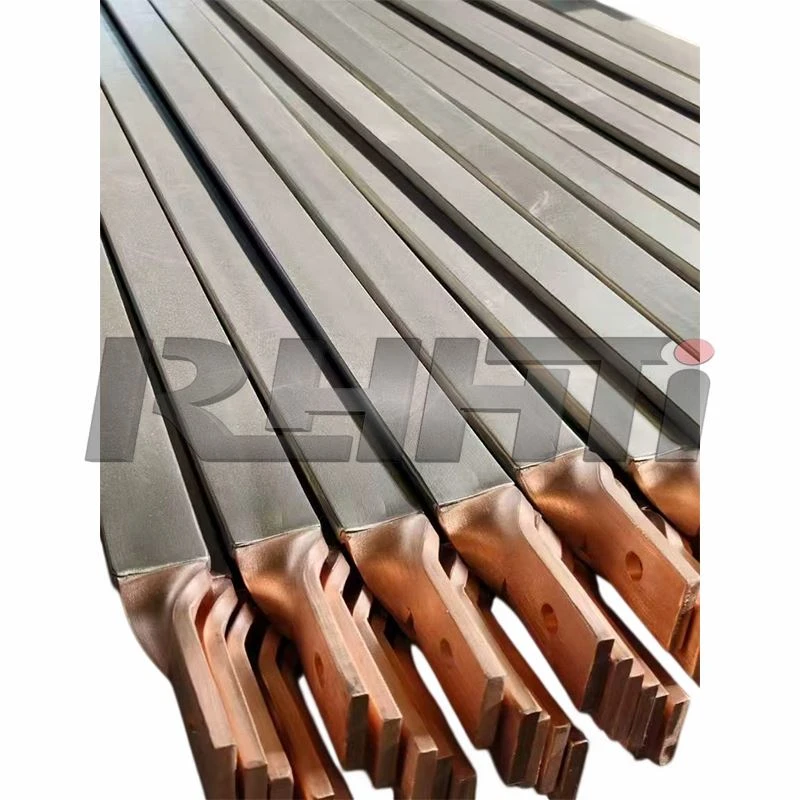

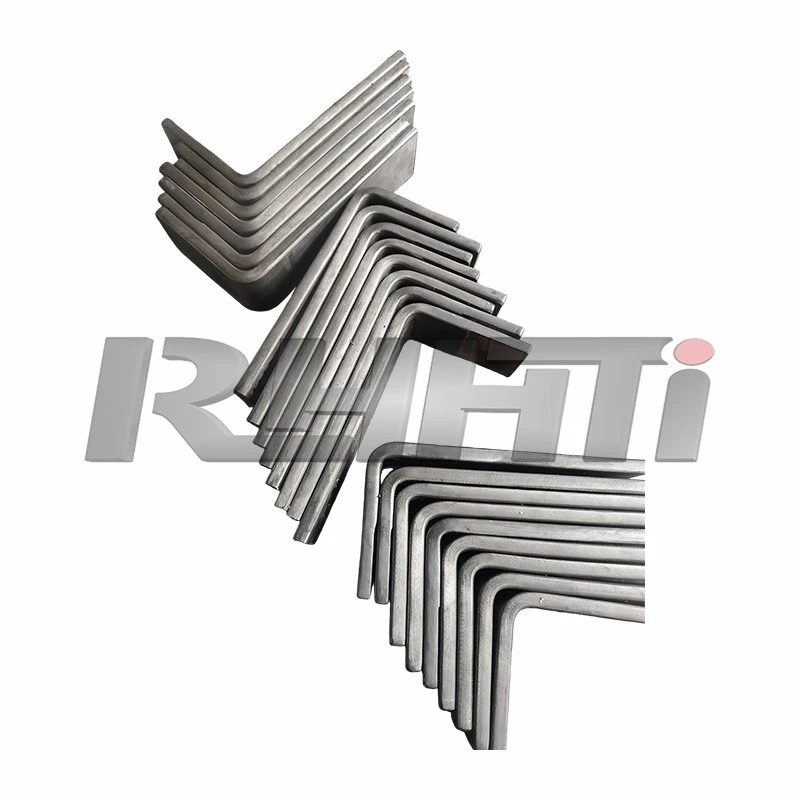
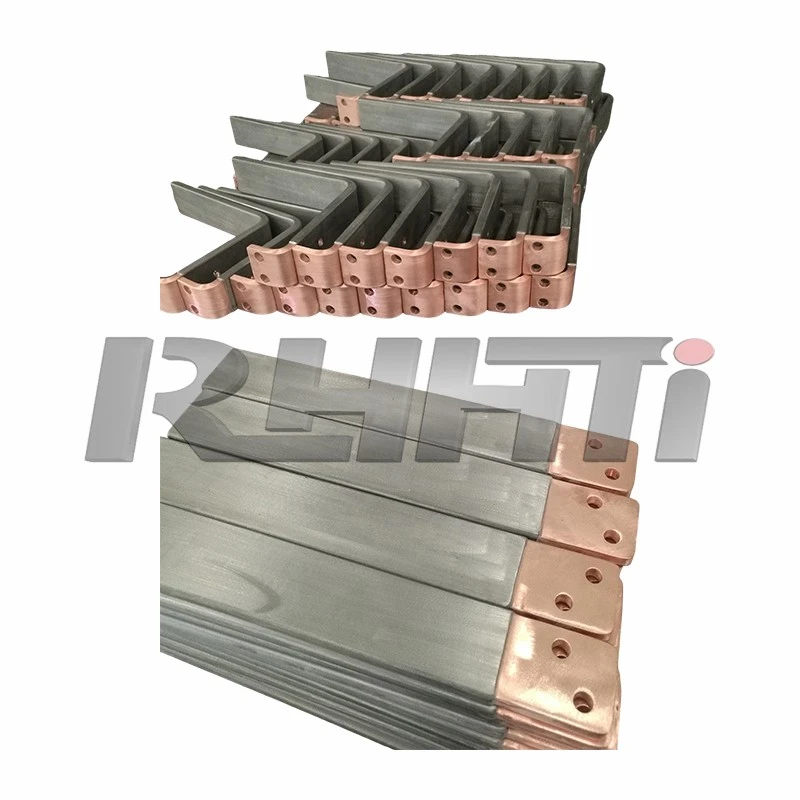
Baoji Ruihenghua Titanium Metal Composite New Materials Co., Ltd. is one of the leading manufacturers and suppliers of titanium copper clad busbar in China. If you're going to buy customized titanium copper clad busbar made in China, welcome to get more information from our factory. For price consultation, contact us.
Titanium Copper Clad Busbar
● Functional Positioning: Core conductive busbar for high current power distribution under highly corrosive working conditions, with a full-surface titanium coating as a corrosion protection barrier, undertaking the functions of current collection at the edge of the electrolysis tank and long-distance power distribution, and adaptable to the conductive transmission of anode and cathode in highly corrosive environments.
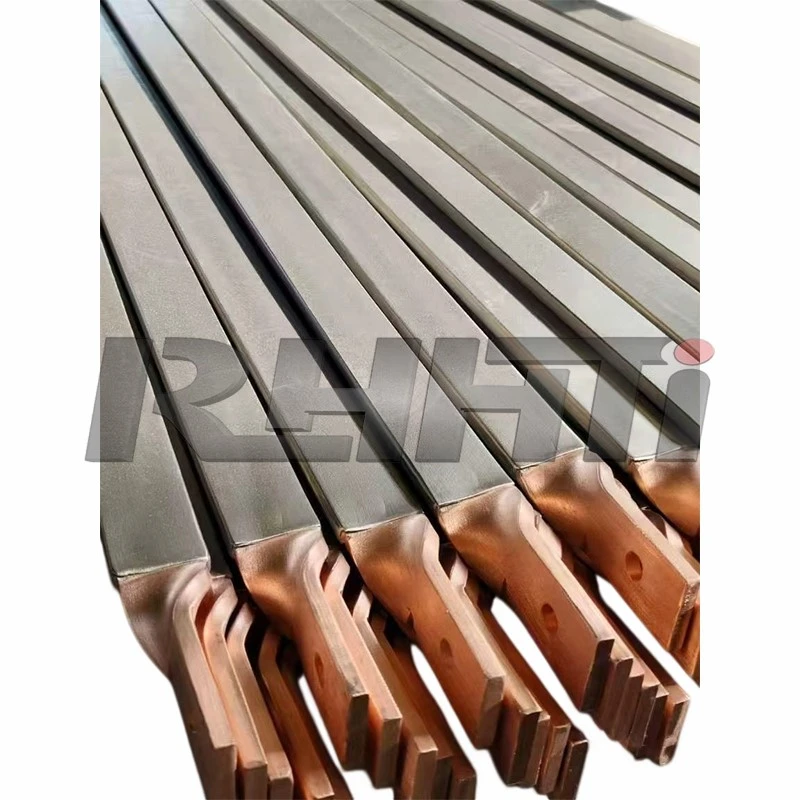
● Coating Structure: Inner layer T2/C11000 high-purity copper conductive core + outer layer TA1/TA2 industrial pure titanium dense coating on the entire surface, with uniform coating thickness and 360° isolation from corrosive media without dead angles.
● Composite Process: Explosive bonding + hot rolling diffusion process achieves metallurgical-grade atomic bonding, with a bonding srength between the coating and the copper core ≥135MPa. The coating does not peel, fall off, or delaminate during long-term operation.
● Conductivity: The copper core has a conductivity of ≥98% IACS. There is no additional contact resistance at the metallurgical interface. The voltage drop and temperature rise are small under high current carrying capacity, making it suitable for high current conditions of thousands to tens of thousands of amperes .
● Corrosion Resistance: The full titanium layer forms a complete anti-corrosion barrier, resisting corrosion from sulfuric acid, chloride ions, alkaline electrolytes and acid mist in the workshop, with a service life more than 10 times that of ordinary pure copper busbars.
● Brand: RHHT i.
● Place Of Origin: Baoji, Shaanxi, China's Titanium Valley.
Product Introduction
Titanium clad copper busbars, also known as fully titanium-clad copper conductive busbars or corrosion-resistant titanium-copper composite busbars, are core bimetallic conductive components developed for highly corrosive electrolytic environments. They utilize a dense titanium cladding across the entire surface as a corrosion barrier, combining high current-carrying capacity with long-term corrosion resistance. The product employs a highly conductive pure copper core and a corrosion-resistant pure titanium outer layer, achieved through explosive bonding and hot-rolling diffusion processes to achieve metallurgical-grade atomic bonding.
Installed as the main current-carrying busbar at the edge of electrolytic cells, in workshop power distribution channels, or inside electroplating tanks, this product is exposed to acid mist, electrolyte splashes, and corrosive atmospheres for extended periods. Unlike traditional pure copper busbars, which suffer from rapid corrosion and wear, high maintenance frequency, and easy electrolyte contamination, and pure titanium busbars, which suffer from high resistivity and high energy consumption, titanium-clad copper busbars offer stable resistance and low voltage drop under long-term high-current operation. The dense titanium layer forms a complete anti-corrosion barrier, significantly extending service life and effectively reducing line voltage drop and overall electricity costs. It is widely used in hydrometallurgical electrowinning, chlor-alkali electrolysis, electrolytic copper foil production, alkaline water electrolysis for hydrogen production, and impressed current cathodic protection, among other engineering applications.
Product Parameter
Implement International Standards System
● Product standards: GB/T 12769-2025 "Titanium-copper composite rod", GB/T 5585.1-2018 "Copper busbars for electrical engineering - Part 1: Hard copper busbars", ASTM B898 "Standard specification for titanium-clad composites".
● Substrate standards: ASTM B265 "Standard Specification for Titanium and Titanium Alloy Plates", ASTM B152 "Standard Specification for Copper and Copper Alloy Rolled Plates and Bars".
● Testing and acceptance standards: GB/T 5121 Chemical analysis methods for copper and copper alloys, GB/T 4698 Chemical analysis methods for titanium and titanium alloys, Ultrasonic non-destructive testing standard for bonding rate, and eddy current testing standard for coating thickness.
● Environmental compliance standards: Complies with the EU RoHS 2.0 directive, and meets standards for harmful heavy metals such as lead, cadmium, and mercury.
● Applicable operating conditions: Suitable for non-ferrous metal electrowinning in sulfuric acid systems, chlor-alkali electrolysis, copper sulfate electrolysis of copper foil, alkaline water electrolysis for hydrogen production, seawater cathodic protection, etc.; Not suitable for extreme corrosion conditions such as high temperature and high concentration of fluoride ions, strong oxidizing molten salts, etc.
Standard Materials And Structural Parameters
|
Parameter Categories |
Optional Specifications |
Illustrate |
|
Inner core conductive substrate |
T2 High Purity Copper / ASTM C11000 Copper |
Conductivity ≥98% IACS, extremely low loss during high current transmission. |
|
Outer titanium coating |
TA1 Industrial Pure Titanium / TA2 Industrial Pure Titanium |
Choose TA2 for normal working conditions, and TA1 for high-cleanliness and high-precision scenarios. |
|
Titanium coating thickness |
0.8mm – 5.0mm |
Uniform and controllable thickness, tolerance ±0.1mm, customizable according to corrosion strength. |
|
Mainstream cross-sectional specifications |
Flat bar: 30×10mm – 250×120mm; Square bar: 20×20mm – 150×150mm |
Flat-panel connectors offer superior heat dissipation and ease of installation, making them the mainstream form in the electrolysis industry. |
|
Single length range |
≤10000mm |
Supports multi-segment splicing to achieve ultra-long distance busbar layout |
|
End connection structure |
Exposed copper ends, titanium-copper transition joints, pre-drilled bolt holes, and weld bevels |
It can meet the needs of on-site bolted and welded connections. |
|
Surface condition of the supplied goods |
Rolled state, pickled and passivated state, machined matte state |
Titanium coating passivation treatment improves corrosion resistance. |
Product Features and Applications
Product Advantages
Full-surface dense coating, 360° corrosion protection without dead angles: Adopting a full-coverage molding process, the titanium layer completely covers all the outer surfaces of the busbar, with no gaps or gaps at the edges and end faces, forming a continuous and sealed anti-corrosion barrier; Compared with partial plating and mechanical coating solutions, it completely prevents corrosive media from seeping in from gaps and end faces, and the long-term protection performance is more reliable.
Metallurgical-grade bonding interface, long-term non-detachment of coating: Titanium and copper are bonded at the atomic level through explosive composite + hot rolling diffusion process. The bonding strength between the coating and the copper core is ≥135MPa, which far exceeds the bonding strength of mechanical coating. Under high current cold and hot cycling and vibration conditions, the coating does not peel, bulge or delaminate. The contact resistance is stable for a long time and there is no additional conductive loss.
High-purity copper core substrate, high current and low loss transmission: The inner core uses high-purity T2 electrolytic copper with a conductivity of ≥98% IACS. There is no additional contact resistance at the metallurgical interface. The line voltage drop and temperature rise are small under long-distance power distribution conditions. The overall power saving rate can reach 10%-15%, which significantly reduces the power transmission and distribution loss in electrolytic production and meets the needs of energy-saving and cost-reducing production.
The coating thickness is precisely controllable and can be matched to the corrosion level as needed: the titanium coating thickness can be precisely customized in the range of 0.8–5.0mm, with a thickness tolerance controllable within ±0.1mm; the corresponding coating thickness can be matched according to the electrolyte corrosion intensity and expected service life, balancing protective performance and project cost, and avoiding cost waste caused by over-configuration.
The connection solution is mature and reliable, and installation and maintenance are convenient: the end caps use a precise stripping process to expose the copper core conductive surface, and a matching titanium-copper transition connector achieves a low-resistance connection; the connection parts can be sealed with titanium for corrosion protection, eliminating corrosion problems at the connection points. It supports both bolt fastening and argon arc welding installation methods, and the finished product is prefabricated as needed, significantly reducing on-site secondary processing.
No impurities are released, ensuring product quality and clean production: The titanium coating is chemically stable and does not react in various electrolytes, nor does it release copper ions. This prevents the electrolyte system from contaminating the cathode product and avoids copper rust dust from polluting the workshop environment, meeting the clean requirements of high-end hydrometallurgy and electronic-grade copper foil production.
Application Areas
Hydrometallurgical industry: Busbars for electrowinning and electrolytic refining cells of non-ferrous metals such as copper, zinc, nickel, and cobalt, and busbars for conductive connections between cells, suitable for high acid and high chloride ion corrosion conditions.
Chlor-alkali chemical industry: Anode busbars of ion-exchange membrane caustic soda electrolytic cells and sodium hypochlorite generators, resistant to chlorine gas and chloride ion corrosion, and suitable for continuous operation with high current.
Electrolytic copper foil industry: Anode conductive busbars and tank-side power distribution busbars of foil production units ensure uniform and stable current, and improve the consistency of copper foil thickness and surface quality.
Electrolysis of water for hydrogen production industry: Anode and cathode busbars of alkaline electrolysis water for hydrogen production cells, and high current transmission busbars of rectifier systems, adapted to the high-load conditions of large-scale green hydrogen projects.
Electroplating and surface treatment industry: conductive busbars in the tanks and conductive beams of hangers in hard chrome plating and PCB plating production lines, resistant to acid and alkali plating solution corrosion, extending the service life of the production line.
Cathodic protection engineering: main power supply busbar and auxiliary anode connection busbar for impressed current cathodic protection systems for large storage tanks, long-distance pipelines, and marine steel structures.
Environmental water treatment industry: Conductive busbars for electrocatalytic oxidation wastewater treatment and heavy metal recovery electrolysis devices, suitable for complex water quality and corrosive environments.
Product Details
Bonding Quality
100% ultrasonic testing of interface bonding rate, effective bonding area ≥98%, no continuous delamination or bubble defects.
01
Coating Accuracy
Titanium coating thickness tolerance ±0.1mm, uniform edge transition, no thin edges or missing areas.
02
Connection Accuracy
Bolt hole position deviation ≤ ±0.5mm, weld bevel angle tolerance ±1°, peeling end face flatness ≤ 0.1mm.
03
Weld Quality
The titanium welds are made using pure argon arc welding, and 100% penetrant testing shows no porosity or cracks. They are then treated with anti-corrosion sealing.
04
Geometric Accuracy
Flatness ≤ 0.3 mm/m, straightness ≤ 1.0 mm/m, cross-sectional dimension tolerance ± 0.3 mm.
05
Product Supporting Documents
Authoritative International Qualification Certificates
Original material certificates for titanium and copper materials; special test reports on the bonding strength, coating thickness, conductivity, and dimensional accuracy of titanium-copper composite materials; original material certificates of EN 10204 3.1 issued for each batch.
ISO 9001 Quality Management System Certification, ISO 14001 Environmental Management System Certification.
Third-party specialized test reports on chemical composition, mechanical properties, corrosion resistance, and bonding strength.
The RoHS environmental compliance test report meets the environmental protection requirements of the chemical, metallurgical, and new energy industries.
thoughtful service
Packaging Standards (For Export By Sea)
Each single-row unit is wrapped with a PE protective film, and a hard protective sleeve is added to the end. The connecting surface is covered with a protective film to prevent scratches, and long poles are supported and fixed with multiple points of wooden blocks.
The entire batch is packed into fumigated solid wood export crates, with pearl cotton filling inside for cushioning and isolation, to prevent bending, deformation, movement and collision during transportation.
The wooden crates are labeled with the product model, dimensions, quantity, gross weight, and moisture-proof/lifting/pressure-proof markings, suitable for all scenarios including sea, land, and air transport.
Professional Consultation Q&A
Q1: How to choose the thickness of the titanium coating? Is thicker always better?
A1: The core difference lies in the bonding method and the protection life: Titanium-plated copper busbars are made of a thin titanium film deposited on the surface by electroplating, with a thickness of only micrometers. The bonding force is weak, it is easy to wear and has many pinholes. Corrosive media can easily penetrate and cause corrosion of the copper substrate. It is usually only used for light decoration or weak corrosion scenarios. Titanium-coated copper busbars are made of millimeter-sized industrial pure titanium plates that are atomically bonded to the copper core through metallurgical processes. The bonding strength is ≥135MPa, the coating is dense and has no pinholes, and the corrosion protection life can reach several to several decades. It is a special solution for strong corrosion electrolysis conditions.
Q2: In the acid mist environment of the workshop, will the busbar connection bolts corrode?
A2: Thicker isn't always better; the thickness must be matched to the corrosion intensity and expected lifespan of the operating conditions. For conventional sulfuric acid electrowinning and weak acid electroplating, a 1.0–2.0 mm titanium coating is sufficient for a 5–8 year service life. For highly corrosive conditions such as chlor-alkali and high-chloride ion environments, a 3.0–5.0 mm titanium coating is recommended, ensuring stable operation for 8–12 years. We will provide precise selection advice based on your specific electrolyte composition, temperature, and expected lifespan, balancing protective performance with project cost.
Q3: Will the cladding layer of titanium-copper clad busbars gradually wear down and thin over long-term use?
A3: Under normal static installation conditions, there will be no significant wear. The titanium coating is harder than pure copper, and electrolytic busbars are mostly fixed installations with no frequent frictional wear. Only in scenarios involving frequent insertion and removal of electrode plates and mechanical friction can the coating in the contact area be thickened or a wear-resistant sleeve be added. Under normal use, the coating corrosion rate is extremely low, and its service life is mainly determined by the corrosive environment, not mechanical wear.
Latest company news
The dedicated production line for titanium-copper composite busbars has been upgraded, and its annual production capacity of coated conductive busbars has exceeded 800 tons.
Based in Baoji, Shaanxi, known as China's Titanium Valley, Baoji Ruihenghua Titanium Metal Composite New Materials Co., Ltd. recently completed the capacity expansion and intelligent upgrade of its titanium-copper composite busbar production line in response to the rapidly growing market demand from the global hydrometallurgy, chlor-alkali chemical, and electrolytic hydrogen production industries.
Leveraging a complete production chain from ingot smelting, forging, rolling to vacuum heat treatment, the upgraded production line is equipped with a brand-new large-scale precision rolling mill, CNC machining center, and fully automated ultrasonic testing equipment. It can achieve standardized mass production of titanium-clad copper busbars with a maximum cross-section of 250×120mm and a single length of up to 10 meters. Production efficiency for standard specifications has increased by 35%, and the delivery cycle for standard batch orders has been shortened to 12 days. Products are manufactured in strict accordance with domestic and international standards such as GB/T 12769 and ASTM B898, and a comprehensive quality traceability system covering incoming inspection, composite processing, finished product testing, and outgoing delivery has been established. This production line upgrade further strengthens the company's supply capacity of high-end electrolytic conductive components, providing a stable product guarantee for global electrolytic engineering projects.
A technological breakthrough has been achieved in the full-surface titanium cladding process, with a titanium-copper busbar interface bonding rate of 99%.
Addressing industry pain points such as localized coating defects and insufficient bonding strength commonly found in traditional titanium-copper busbar products, the company's R&D team has made significant progress in optimizing the explosive bonding + hot rolling diffusion bonding process.
The optimized full-surface coating process achieves a 360° seamless encapsulation of the copper core by the titanium layer, with uniform titanium coating thickness and tolerance controlled within ±0.1mm. The interfacial metallurgical bonding rate exceeds 99%, and the shear strength can reach up to 260MPa. This effectively solves problems such as edge leakage, coating peeling, and interlayer liquid flow under highly corrosive electrolysis conditions. Compared with conventional products, the product's service life is increased by more than 20% in high-chlorine and high-acid electrolysis environments. It has been successfully applied in high-end scenarios such as electrolytic copper foil production, ion-exchange membrane chlor-alkali production, and alkaline water electrolysis for hydrogen production, providing a more reliable conductive solution for high-end electrolysis engineering projects.
The global customization service for titanium-copper busbars has been fully upgraded, and a comprehensive technical support system has been officially launched.
Leveraging its independent import and export qualifications, the company has comprehensively upgraded its global customized service system for titanium-copper composite busbar products, creating a one-stop service system covering pre-sales condition assessment, solution design, in-sales production follow-up, and after-sales installation guidance.
For clients in industries such as hydrometallurgy, chlor-alkali chemicals, and new energy hydrogen production, the company provides professional value-added services including current carrying capacity calculation, busbar layout design, titanium layer thickness selection, and thermal expansion compensation solutions. The company collaborates with several internationally renowned logistics carriers, offering diversified delivery options such as sea freight, air freight, and China-Europe freight trains. Each batch of products comes with an original manufacturer's material certificate conforming to EN 10204 3.1, and bulk orders support testing by third-party organizations such as SGS and BV. Professional engineers provide 24/7 online technical support, committed to becoming a trusted long-term partner for global electrolysis industry clients, providing integrated solutions from composite material R&D to finished product application.
Hot Tags: titanium copper clad busbar, China titanium copper clad busbar manufacturers, suppliers, factory, Copper Busbar Conductive Beam, Ti Clad Copper Busbar, Titanium Copper Clad Busbar, titanium-copper busbar