

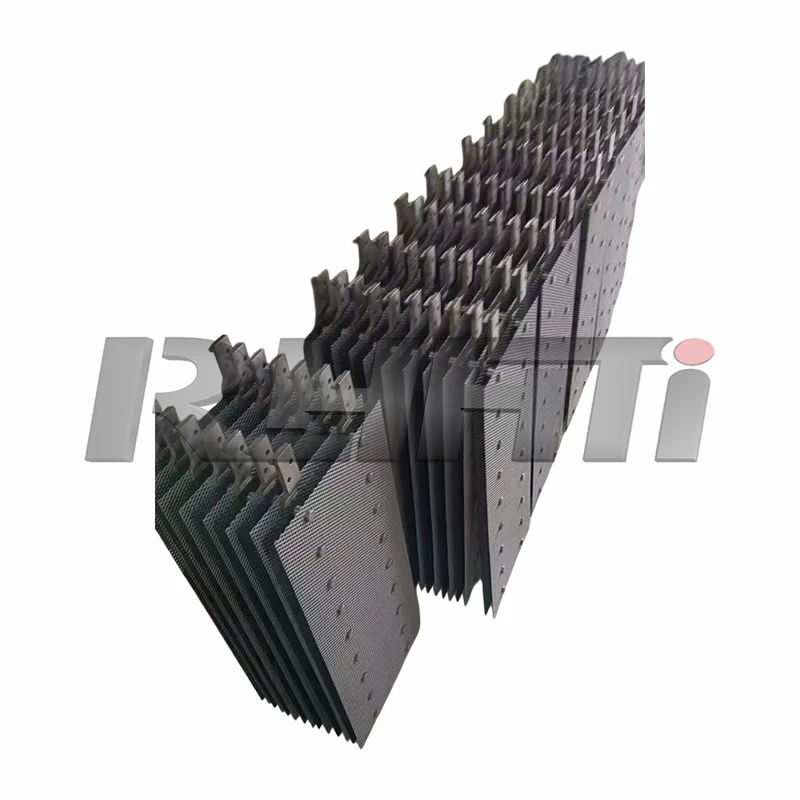


Baoji Ruihenghua Titanium Metal Composite New Materials Co., Ltd. is one of the leading manufacturers and suppliers of ruthenium titanium oxide coated titanium anode plate in China. If you're going to buy customized ruthenium titanium oxide coated titanium anode plate made in China, welcome to get more information from our factory. For price consultation, contact us.
Product Overview
Our factory`s ruthenium titanium oxide coated titanium anode plates are custom-engineered for the electrolytic recovery of copper from acidic cupric chloride etching waste (used in acidic etching lines). The substrates utilize globally standard Grade 1 (UNS R50250) and Grade 2 (UNS R50400) high-purity titanium, strictly adhering to ASTM B265 and ISO 5832-1 international industrial standards, with a titanium purity of ≥99.6%.
Unlike Iridium-Tantalum (Ir-Ta) MMO anodes (suited for alkaline/micro-etching baths) or Lead Dioxide anodes (for high-current applications), our Ru-Ti mixed metal oxide coating features an ultra-low chlorine evolution overpotential and excellent resistance to chloride ion corrosion. It maintains stable catalytic activity over the long term in acidic etching waste characterized by high chloride ion concentrations and low organic impurity levels. It serves as the standard chlorine-evolving MMO electrode for copper recovery from acidic PCB etching waste, effectively resolving issues such as anode coating passivation and skyrocketing cell voltages in high-chloride environments; it ensures stable cell voltage and lower power consumption during continuous, long-cycle operations.
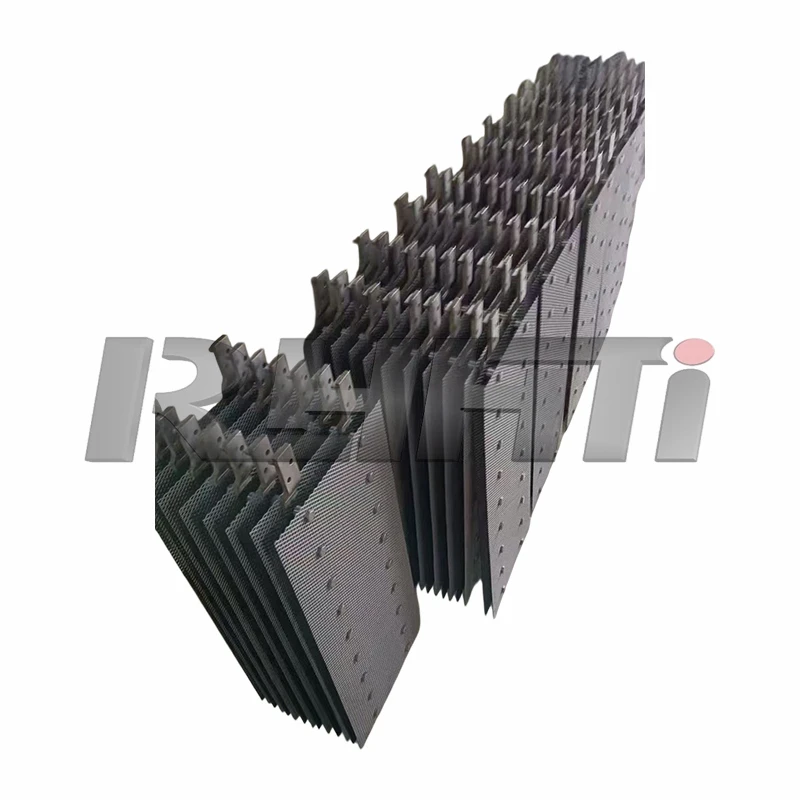
There is no dissolution of titanium substrate metal ions during the electrolysis process, and the recovered cathode copper achieves a purity of ≥99.9%, preventing secondary heavy metal contamination of the electrolyte. Once the surface Ru-Ti catalytic coating loses activity, the intact Grade 1/Grade 2 titanium substrate can be stripped of the old coating via sandblasting and recoated for reuse, significantly reducing long-term procurement costs. The service life ranges from 1.2 to 3 years under stable, 24-hour continuous acidic waste recovery operations.
We support various configurations, including solid plates, expanded titanium mesh, and solid titanium rods; plate thickness, overall dimensions, and conductive tab structures can all be fully customized (OEM). With over a decade of experience in the R&D and manufacturing of international-standard Ru-Ti MMO titanium anodes, we supply products in bulk to PCB manufacturers, electronic waste recyclers, and hydrometallurgical enterprises across Southeast Asia, Europe, the Americas, Africa, and Latin America.
Product Parameters
|
Parameter Item |
International Standard Specifications |
| Titanium Substrate Grade (UNS) |
Grade 1 Titanium: UNS R50250; Grade 2 Titanium: UNS R50400; Standards: ASTM B265, ISO 5832-1; Titanium purity ≥99.6% |
| MMO Catalytic Coating Formula |
RuO₂-TiO₂ (Ruthenium-Titanium mixed metal oxide) |
| Ruthenium (Noble Metal) Loading | 12–35 g/m² (customizable upon request) |
| Coating Thickness |
7–14 μm (uniform, dense catalytic layer with characteristic "mud-crack" pattern) |
| Compatible Waste Liquid Types |
PCB acidic cupric chloride etching waste; high-chloride acidic copper-bearing wastewater; low-impurity chloride etching solutions |
| Operating Current Density Range |
100–2500 A/m² (stable medium-load chlorine evolution current) |
| Continuous Operating Temperature |
40–60°C |
| Operating PH Range |
0.5–5 (strong to weak acid; optimized for acidic bath applications) |
| Rated Service Life |
1.2–3 years (stable performance under continuous electrolysis conditions) |
| Electrode Forms |
Solid titanium plate, expanded titanium mesh, solid titanium rod; full-size OEM customization supported |
| Recovered Cathode Copper Purity |
≥99.9% (high-purity electrolytic copper) |
| Core Unique Features |
Ultra-low chlorine evolution overpotential; excellent resistance to chloride ion corrosion; recyclable/re-coatable titanium substrate; energy-efficient design specialized for acidic chloride waste |
| Compatible Cathodes |
316L (UNS S31603) stainless steel cathode plate; LDX2101 (UNS S32101) duplex stainless steel cathode plate |
Core Product Advantages
Specialized RuO₂-TiO₂ Chlorine-Evolution Coating
This Ruthenium-Titanium MMO coating is specifically matched to acidic cupric chloride etching solutions. It utilizes ruthenium oxide as the active phase for chlorine evolution and titanium dioxide as the anti-corrosion carrier phase, formed via staged high-temperature thermal decomposition into a dense, uniform surface layer with a characteristic "mud-crack" pattern. Compared to Iridium-Tantalum coatings-which are suited only for alkaline or micro-etching solutions-this coating offers significant performance advantages in high-chloride acidic cupric chloride baths; it inhibits passivation, prevents rising cell voltage and premature failure, and ensures consistently low power consumption during long-term mass production.
Ultra-Low Chlorine-Evolution Overpotential And Outstanding Energy Efficiency In Chloride Systems
The Ru-Ti catalytic layer reduces the chlorine-evolution overpotential by 0.3–0.5V compared to Iridium-Tantalum or Lead Dioxide anodes, resulting in 10–16% energy savings under low-to-medium continuous current conditions. It is the preferred energy-saving electrode for small- and medium-sized PCB acidic etching waste copper recovery lines, significantly cutting daily electricity and operational costs for acidic PCB workshops.
Recyclable Titanium Substrate And Lower Total Lifecycle Costs
During long-term operation, only the surface Ru-Ti MMO coating deactivates; the intact Grade 1 or Grade 2 titanium substrate can be professionally sandblasted to remove the old coating and re-sintered with a new standard RuO₂-TiO₂ catalytic layer, eliminating the need to scrap and replace the entire anode. Within three years of commissioning an acidic PCB waste treatment project, total expenditure on equipment procurement and maintenance can be reduced by over 50%.
Application Scenarios
This titanium-based Ruthenium-Titanium oxide anode plate is a specialized, energy-saving inert electrode designed for closed-loop waste recovery in PCB acidic etching workshops worldwide. Widely used in hydrometallurgical electrolytic recovery processes, such as the regeneration of acidic copper chloride etching waste and copper extraction, copper removal from high-chloride acidic wastewater, and the resource recovery/regeneration of low-impurity chlorinated industrial waste liquids. When paired with UNS S31603 (316L) or UNS S32101 (LDX2101) stainless steel permanent cathode plates, it forms a complete zero-emission electrolytic copper recovery system. This system simultaneously recovers high-purity cathode copper and regenerates recyclable acidic etching solution, significantly reducing hazardous waste disposal costs for PCB factories and enhancing resource recycling rates.
Product Details
Original Grade 1/Grade 2 High-Purity Titanium Coil (ASTM/ISO Compliant)
The titanium coils strictly adhere to ASTM B265, ISO 5832-1, and UNS grade specifications, featuring a titanium purity of ≥99.6%. Each batch offers consistent mechanical strength, ductility, and resistance to chloride-ion corrosion, ensuring no warping, peeling, or pitting during long-term electrolysis in high-chloride acidic mixed waste solutions.
Multi-stage Pre-treatment & Segmented Gradient Thermal Decomposition MMO Coating Process
Employs multiple surface treatment steps-including degreasing, sandblasting, and acid pickling/activation-to increase the coating bonding area and adhesion. A ruthenium-titanium (Ru-Ti) precious metal mixture is applied evenly, followed by a segmented gradient high-temperature sintering process (430–530°C) to form a dense, "mud-crack" patterned catalytic coating that is uniform in thickness and resistant to chloride-ion erosion and peeling.
Rigorous Comprehensive Factory Testing
Every finished Ru-Ti MMO titanium anode undergoes four critical tests: coating adhesion/peel testing, accelerated acidic chloride corrosion simulation, chlorine evolution overpotential testing, and continuous current stability testing. All performance indicators meet global industry standards for PCB acidic etching solution copper recovery electrodes.
Product Qualifications and Credentials
Our factory specializes in manufacturing international-standard Ru-Ti MMO DSA (Dimensionally Stable Anode) inert titanium anodes. We possess complete production qualifications and operate an independent laboratory for testing coating performance. All Ru-Ti MMO titanium anodes designed for copper recovery from etching solutions are manufactured in compliance with HG/T2471-2007, ASTM B265, and ISO 5832-1 standards. They support third-party authoritative testing (SGS, ISO) for materials and coatings, and come with complete documentation, including the original titanium material certificate (MTC), coating ruthenium content test reports, and full factory qualification papers. The products meet EU REACH industrial environmental standards and are suitable for procurement by electronics manufacturing waste recovery plants worldwide.
Logistics and After-Sales Service
Packaging And Shipping
Reinforced solid wood protective frames combined with double-layer anti-scratch foam inner packaging provide comprehensive protection for the uniform Ru-Ti MMO catalytic coating, preventing scratches, oxidation, or damage during long-distance ocean transport. Standard specifications are available from stock for delivery within 3–5 working days; custom orders regarding thickness, shape, ruthenium loading, and conductive tab structures support expedited OEM production. Global logistics channels-including sea freight, air freight, and international express-ensure stable delivery.
After-Sales Support
One-stop free pre-sales technical consultation: matching anode specifications to acidic etching waste conditions (chloride ion concentration and pH), selecting titanium substrate grades, customizing Ru-Ti loading, adjusting electrode dimensions via OEM, and providing guidance on compatibility with electrolytic cells and stainless steel cathodes. Long-term professional services are provided for stripping and recoating used Ru-Ti MMO anodes. Free replacements are offered for verified manufacturing defects in the original coating, ensuring zero-risk procurement for global PCB waste recovery operations.
Frequently Asked Questions
Q1: What are the key differences between Ru-Ti MMO anodes, Ir-Ta MMO anodes, and PbO₂ anodes in PCB copper recovery applications?
A1: Ru-Ti anodes are specifically designed for acidic cupric chloride high-chloride etching waste solutions; they feature extremely low chlorine evolution overpotential, energy efficiency, and strong resistance to chloride ion corrosion, making them suitable for moderate, stable current loads. Ir-Ta coatings are suitable only for alkaline ammonia-based and micro-etching waste solutions, where the oxygen evolution reaction predominates. PbO₂ anodes can withstand very high current densities and have lower raw material costs, making them suitable for high-flow, high-concentration waste solutions, though they consume more power under low-to-medium current conditions.
Q2: How do you choose between Grade 1 and Grade 2 titanium substrates for Ru-Ti anodes?
A2: For the vast majority of standard PCB acidic etching waste recovery projects, the mainstream, cost-effective Grade 2 titanium (UNS R50400) is selected. Grade 1 titanium (UNS R50250) offers superior ductility and is used only for the custom production of ultra-thin expanded mesh Ru-Ti electrodes.
Q3: Can the titanium substrate be reused after the Ru-Ti catalytic coating fails?
A3: Yes. Once the surface catalytic coating deactivates, the intact titanium plate can undergo professional coating removal and be re-sintered with a brand-new, standard RuO₂-TiO₂ MMO layer, saving over 50% compared to the cost of purchasing a new anode.
Q4: Can anode dimensions, mesh types, and Ru-Ti coating loadings be customized?
A4: Yes, full OEM customization is supported. Anode thickness, length and width, mesh specifications, Ru-Ti loading, and the welding position of conductive tabs can all be adjusted according to the internal dimensions of the customer's electrolytic cell.
Company Updates
For over a decade, our factory has specialized in the R&D and manufacturing of international-standard RuO₂-TiO₂ MMO titanium anodes designed for PCB acidic cupric chloride etching waste recovery. We continuously optimize our segmented gradient high-temperature sintering coating process to enhance coating density, resistance to chloride ion corrosion, and long-term operational stability. Our products are widely exported to PCB manufacturing and waste recovery plants across Southeast Asia, Europe, and the Americas, and we have established long-term, stable strategic partnerships with dozens of international electronics industry groups.
Hot Tags: ruthenium titanium oxide coated titanium anode plate, China ruthenium titanium oxide coated titanium anode plate manufacturers, suppliers, factory, Iridium Tantalum MMO Titanium Anode Plate, Lead Dioxide Coated Titanium Anode Plate, Platinum Coated Titanium Anode Plate, Ruthenium Titanium Oxide Coated Titanium Anode Plate, Titanium Anodes For Copper Recovery From Etching Solutions, titanium-based precious metal coating