

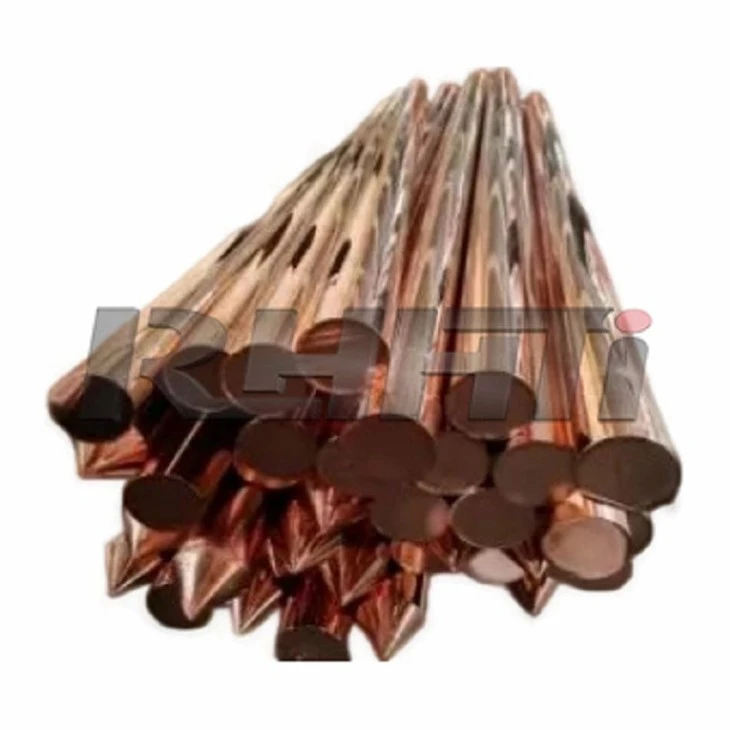


Baoji Ruihenghua Titanium Metal Composite New Materials Co., Ltd. is one of the leading manufacturers and suppliers of copper clad steel bars in China. If you're going to buy customized copper clad steel bars made in China, welcome to get more information from our factory. For price consultation, contact us.
Product Introduction
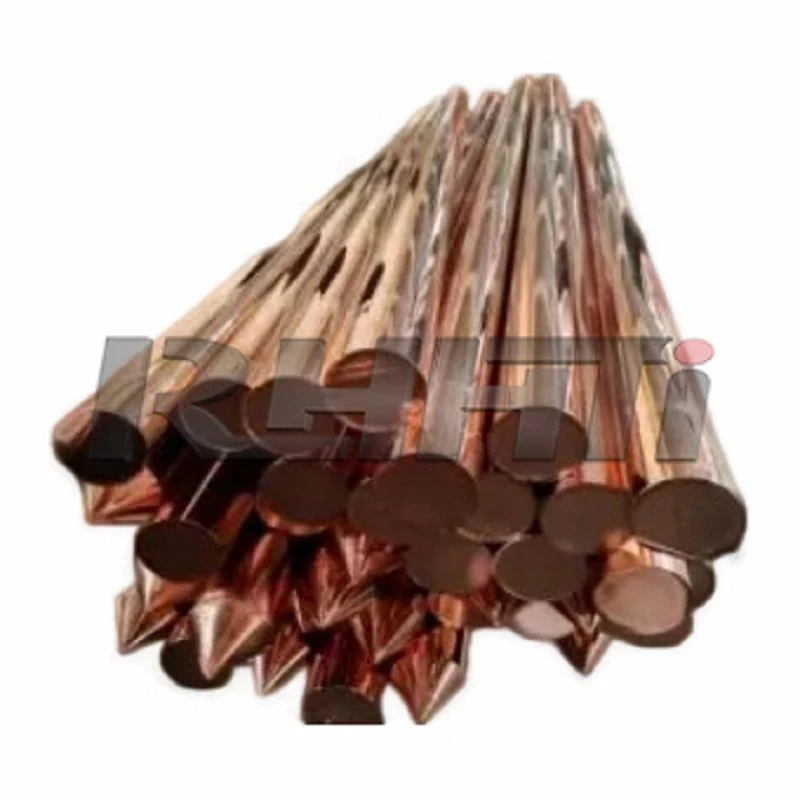
Copper clad steel bars are high-performance bimetallic composite materials prepared using explosive welding and precision drawing processes. High-purity copper is uniformly coated onto a carbon steel core, achieving a 360° circumferential metallurgical bond. This process combines the excellent electrical and thermal conductivity of copper with the high strength and impact resistance of carbon steel. Unlike electroplating or mechanical coating products, the explosive metallurgical bond achieves an atomic-level bond, resulting in a bond strength far exceeding traditional processes. Long-term use eliminates the risk of peeling, blistering, or copper layer detachment. Compared to pure copper bars, material costs are reduced by 40%-60% while meeting conductivity requirements, and structural strength and impact resistance are significantly improved. Compared to pure steel bars, conductivity is increased by more than 5 times. Widely used in lightning protection grounding, electroplating fixtures, power transmission, and communication engineering, it is a cost-effective core material for conductive load-bearing applications.
Product Parameter
Implement International Standards System
● Copper outer layer material standard: ASTM B187 (Standard specification for copper and copper alloy bars and profiles).
● Carbon steel core layer standard: ASTM A36 (Standard Specification for Structural Carbon Steel).
● Composite processes and testing: Specifications for explosive welding of dissimilar metals, standards for ultrasonic flaw detection.
● Acceptance and quality assurance standards: EN 10204 3.1 Original manufacturer's material certificate.
Standard Material Grades (Internationally Recognized Grades)
|
Layered Structure |
Optional International Brands |
Functional And Operating Condition Adaptation |
|
Copper Outer Layer |
C11000 ETP Copper |
A highly conductive and thermally conductive functional layer ensures overall conductivity, and its thickness can be adjusted to precisely control conductivity. |
|
Steel Core Substrate |
A36 Structural Carbon Steel |
Provides structural strength and impact resistance, reduces overall material costs, and is suitable for load-bearing and stress conditions. |
Product Features and Applications
Product Advantages
Explosive metallurgical bonding, stable and reliable performance: Explosion-driven atomic-level metallurgical bonding is achieved, and the interface has a regular wavy structure. The bonding strength is much higher than that of electroplated and mechanically coated products. There is no risk of blistering, peeling or copper layer falling off during long-term use. It can withstand various processing and stress conditions such as pulling, bending and impact. The conductivity is continuous and stable, and there is no problem of increased contact resistance.
High strength and high conductivity offer outstanding cost-effectiveness: The outer layer of copper ensures excellent electrical and thermal conductivity, while the core layer of carbon steel provides high-strength structural support. It is more than 40% lighter than pure copper rods for the same conductivity, reducing material costs by 40%-60%. Its conductivity far exceeds that of pure steel rods for the same strength, perfectly balancing performance and procurement costs.
Flexible thickness ratio, precisely adaptable to needs: The copper layer thickness can be customized between 0.2-5mm to meet different conductivity and corrosion allowance requirements. It can be precisely matched from low current grounding to high current conductive busbars, avoiding cost waste caused by performance redundancy.
Excellent corrosion resistance and processing performance: The copper layer has good atmospheric and soil corrosion resistance, and can be further tin-plated or zinc-plated to improve corrosion resistance; it supports a variety of deep processing such as turning, drilling, bending, welding, and crimping, and can be directly made into various finished components, which are convenient for on-site installation.
It offers diverse connection methods and high construction efficiency: it can be connected to other conductors through various methods such as welding, bolting, crimping, and exothermic welding. The joint processing technology is mature and adaptable to the installation requirements of multiple scenarios such as power, grounding, and electroplating. It boasts high construction efficiency and stable connection.
Application Areas
Power lightning protection: grounding electrode, lightning protection down conductor, horizontal conductor of grounding grid, substation grounding system, building lightning protection grounding.
Electroplating industry: Electroplating rack substrate, rack main rod, conductive crossbeam, suitable for conventional acid and alkali electroplating conditions.
Power transmission: low-voltage conductive busbars, conductive components of switchgear, conductive bars of high-power equipment, conductors of power distribution systems.
Telecommunications engineering: grounding system for communication base stations, grounding electrode for signal towers, and grounding conductor for low-voltage systems.
Rail transit: track grounding conductors, vehicle conductive components, and signal system grounding components.
Municipal engineering: auxiliary anodes for cathodic protection, pipeline grounding, and grounding grids for petrochemical plants.
Product Details
Outer copper surface
Default is bright surface, optional fine grinding and polishing, wire drawing, tin plating, zinc plating to improve corrosion resistance and conductivity.
End face treatment
The default is flat cut, but chamfering and copper layer sealing treatment can be performed to prevent the steel layer on the end face from being exposed to corrosive media.
Straightness
Standard grade ≤1.0mm/m, Precision grade ≤0.5mm/m.
Product Supporting Documents
Authoritative International Qualification Certificates
ASTM B187 and ASTM A36 material testing reports, and original manufacturer material certificates in EN 10204 3.1 for each batch.
ISO 9001 Quality Management System Certification, ISO 14001 Environmental Management System Certification.
Third-party SGS test report on the bonding strength, conductivity, and corrosion resistance of the dual interfaces.
Testing qualifications for materials used in power grounding and electroplating industries.
thoughtful service
Packaging Standards (For Export By Sea)
Each product is individually wrapped with a PE protective film and pearl cotton, and a plastic protective cap is added to the end.
The entire batch was packed into fumigated solid wood export crates, with the interior filled with shock-absorbing foam. + Moisture-proof desiccant.
The wooden crates are labeled with material grade, specifications, number of pieces, gross weight, and moisture-proof/lifting markings, suitable for all scenarios including sea, land, and air transport.
Professional Consultation Q&A
Q1: In lightning protection grounding projects, what are the actual differences between explosively bonded copper-clad steel rods and electroplated copper-clad steel or pure copper grounding rods?
A1: The core differences among the three are in bonding strength, service life, and overall cost: Electroplated copper-clad steel has a thin copper layer (usually around 0.25mm), weak bonding force, and is prone to peeling and flaking when bent or driven into the ground. It also corrodes quickly and has a service life of generally 5-10 years, making it the cheapest option; Pure copper grounding rods have the best conductivity and strong corrosion resistance, but low strength, are easy to bend when driven in, and have extremely high material costs, resulting in high costs for large-scale projects; Exploded composite copper-clad steel rods offer a wide range of copper layer thickness options, an interface metallurgical bonding strength ≥140MPa, do not delaminate when bent or impacted, have a uniform copper layer that is not easily corroded, and can last for more than 30 years. The cost is only 40%-60% of that of pure copper, making it the optimal choice for balancing performance and cost in engineering projects, especially suitable for grounding systems with complex geology and long service life designs.
Q2: What is the relationship between the conductivity of copper-clad steel rods and the thickness of the copper layer, and how should the thickness be selected for different scenarios?
A2: Conductivity is mainly determined by the cross-sectional area ratio of the copper layer. The thicker the copper layer, the higher the overall conductivity: 0.2-0.5mm copper layer corresponds to 20%-30% IACS, suitable for low-current scenarios such as lightning protection and weak current grounding in ordinary civil buildings; 0.8-1.5mm copper layer corresponds to 30%-50% IACS, suitable for conventional power distribution grounding, electroplating fixtures, and low-voltage conductive busbars; copper layers above 2.0mm correspond to 50%-70% IACS, suitable for high-current conduction, high-requirement grounding, and heavily corrosive soil scenarios. Thicker is not always better. Prioritize determining the required conductivity based on current carrying capacity and grounding resistance requirements, then consider the soil corrosion level and allow for corrosion tolerance before finalizing the copper layer thickness to avoid unnecessary cost waste.
Q3: If a copper-clad steel grounding rod is buried in the soil for a long period of time, will the copper and steel form galvanic corrosion, leading to premature failure?
A3: As long as the end seals are properly maintained, significant galvanic corrosion failure will not occur in normal soil environments. Firstly, the copper layer completely covers the steel core, preventing the formation of a large cathode and small anode corrosion circuit; only exposed end faces will experience localized galvanic corrosion. Secondly, our products can be shipped with copper layer sealing welding, completely sealing the end face steel core and eliminating corrosion entry points at the source. For highly corrosive soils such as those with high salinity, alkalinity, or strong acids and alkalis, a thicker copper layer and surface tin/zinc plating can be chosen to further extend the corrosion resistance lifespan. In actual engineering projects, as long as the copper layer is not scratched during construction and the joints and end faces are properly sealed, the service life can easily meet the design requirement of over 30 years.
Latest company news
The full range of copper-steel composite materials has achieved mass production, covering three major categories: bars, tubes, and conductive beams.
Baoji Ruihenghua Titanium Metal Composite New Materials Co., Ltd., based on 20 years of experience in non-ferrous metal composite processing in China's Titanium Valley, has officially expanded its copper-based composite material product matrix. The three core product lines of electrolytic conductive beams, copper-clad steel bars, and copper-clad steel pipes have all achieved standardized mass production.
All products are manufactured using explosive welding and precision forming processes, achieving a complete metallurgical bond at the interface, with shear strength exceeding industry benchmarks. The electrolytic conductive beam serves the dual function of supporting the electrode plates and transmitting high current, saving over 30% more energy compared to pure titanium beams. Copper-clad steel rods are primarily used for lightning protection grounding and electroplating fixtures, with costs 40%-60% lower than pure copper rods. Copper-clad steel pipes are designed for heat exchange and pressurized fluid transport, with a pressure-bearing capacity 2-3 times that of pure copper pipes and heat exchange efficiency approaching that of pure copper pipes. Currently, the company's annual production capacity of copper-steel composite series reaches 800 tons, covering all specifications from φ5mm to φ219mm, providing one-stop copper-based composite material solutions for customers in the global hydrometallurgy, power, heat exchange, and petrochemical industries.
Full-scenario customization service launched, providing one-stop supply from base materials to finished components.
In response to the diverse working conditions and needs of global customers, the company has officially launched a full-dimensional customization service system for copper-steel composite products.
Electrolytic conductive crossbeams can be customized in terms of outer layer material (titanium/stainless steel/nickel), cross-sectional dimensions, copper core ratio, and end connection structure according to electrolyte properties and current load, providing a 1:1 match with existing electrolytic cell production lines. Copper-clad steel bars can have their copper layer thickness adjusted within the range of 0.2mm–5.0mm to precisely match the conductivity and corrosion allowance requirements of grounding, electroplating, and other scenarios. Copper-clad steel pipes support wall thickness ratios, customized pipe diameters, and deep processing such as bending, flaring, and flange welding, and can be directly used in heat exchanger tube bundles and pressure piping systems. Professional engineers provide pre-sales condition assessments and full-process technical support to help customers optimize material costs and improve equipment operating efficiency.
Copper-steel composite products are accelerating their global expansion and are being widely adopted in metallurgy, power, heat exchange, and other industries.
With its independent import and export qualifications for goods and technology, the company's copper-steel composite series has been supplied to markets in Europe, Southeast Asia, North America, and the Middle East, and has been applied in batches in multiple fields such as hydrometallurgy, power grid construction, and petrochemical heat exchange.
Each batch of products comes with an original manufacturer's material certificate conforming to EN 10204 3.1 and supports testing by third-party organizations such as SGS and BV. The company collaborates with internationally renowned logistics carriers, providing diversified delivery solutions including sea freight, air freight, and China-Europe freight trains. It also offers 24/7 online technical support, covering the entire process from on-site welding guidance and routine maintenance to troubleshooting. Leveraging its integrated industrial chain advantage from explosive composite substrates to finished product processing, the company is committed to becoming a reliable long-term supplier of copper-based composite materials to global customers.
Hot Tags: copper clad steel bars, China copper clad steel bars manufacturers, suppliers, factory, Anode For Water Electrolysis, Cathode Flying Target For PCB, Copper Clad Steel Bars, Copper Clad Steel Pipe, copper-clad steel, Electrolytic Conductive Beam