

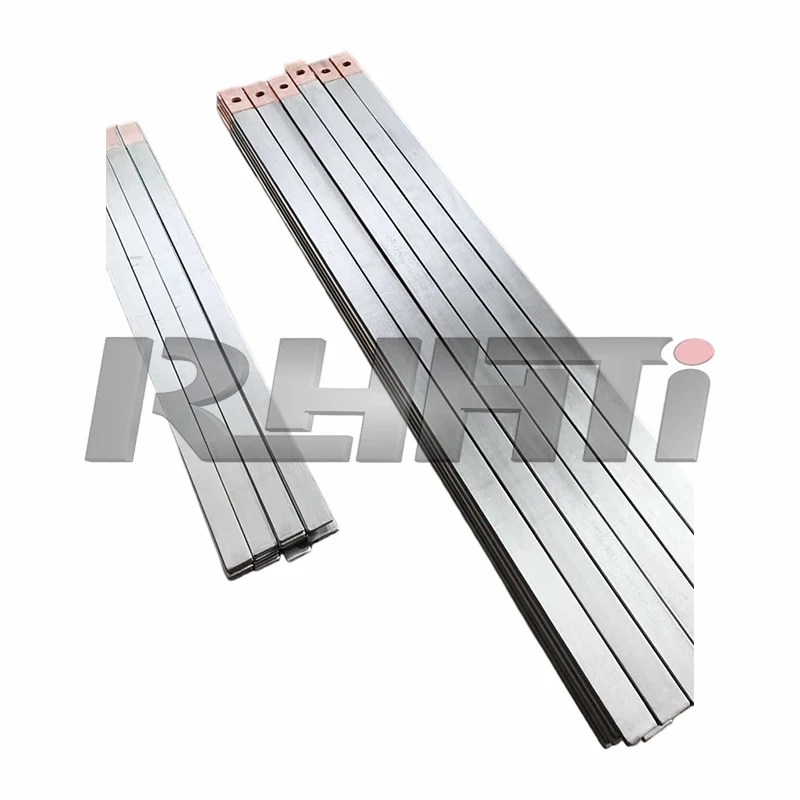


Baoji Ruihenghua Titanium Metal Composite New Materials Co., Ltd. is one of the leading manufacturers and suppliers of titanium clad copper conductive beam in China. If you're going to buy customized titanium clad copper conductive beam made in China, welcome to get more information from our factory. For price consultation, contact us.
Titanium Clad Copper Conductive Beam
● Integrated Multi-Functional Components: simultaneously realize three major functions: high current conduction, electrode plate load-bearing support, and corrosion protection and isolation, replacing the traditional pure copper crossbeam + external anti-corrosion sleeve two sets of accessories, simplifying the assembly structure of the electrolytic cell.
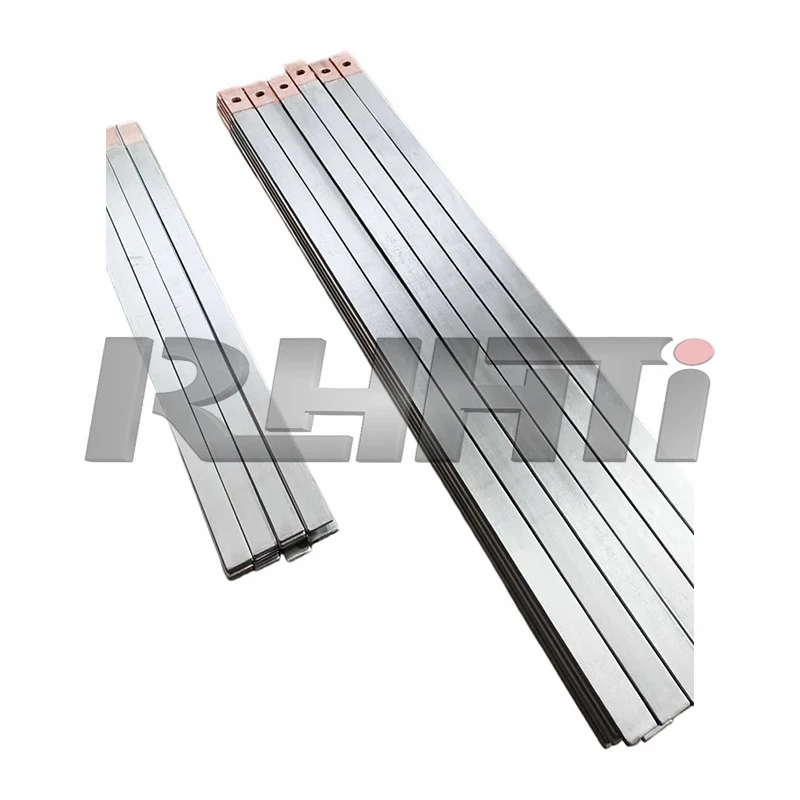
● Standard Metallurgical Composite Structure: inner core T2/C11000 high-purity oxygen-free copper, outer layer 360° fully encapsulated TA2 Gr2 industrial pure titanium, the liquid surface is fully sealed with titanium to isolate the corrosive electrolyte, and a bare copper conductive wiring area is reserved above the liquid surface.
● Composite Process: Titanium and copper are atomically tightly bonded, with an interfacial shear strength ≥135MPa. No delamination or peeling occurs during bending, drilling, heavy-duty long-term use, and the contact resistance remains stable without increasing.
● Energy-Saving Advantages: Copper core conductivity ≥99% IACS, voltage drop is reduced by 20%-35% compared with pure titanium conductive beam for the same current carrying capacity, and 24-hour continuous electrolysis significantly reduces factory electricity consumption.
● Fully Aealed Corrosion Protection: The titanium layer forms a dense passivation film in sulfuric acid, chloride salts, fluoroboric acid, and caustic soda electrolytes, preventing copper ion precipitation and contamination of the plating solution, reducing the frequency of electrolyte replacement and improving the purity of electroplated/electrolytic metal products.
● Brand: RHHT i.
● Place Of Origin: Baoji, Shaanxi Province, China's Titanium Valley.
Product Introduction
Titanium clad copper conductive beams are integrated heavy-duty conductive load-bearing components developed for various electrolytic cells and automated electroplating production lines. Unlike ordinary simple composite busbars, the beam's cross-sectional structure is optimized for long-term heavy-load electrode plate suspension. The product employs an explosive welding + vacuum hot rolling composite process, using high-purity oxygen-free copper as the internal conductive core material. The entire immersion area in the electrolytic bath is fully encapsulated with a TA2 pure titanium anti-corrosion layer. The metallurgical interface eliminates the contact resistance increase caused by delamination, and the titanium cladding completely isolates various corrosive electrolytes, preventing copper ion precipitation and contamination of the electrolyte. This single component simultaneously bears three core functions: high-current transmission, electrode plate suspension and load-bearing, and dielectric corrosion protection. It is widely used in copper-zinc-nickel hydrometallurgical electrowinning, chlor-alkali membrane electrolysis, PCB vertical swing electroplating, electrolytic copper foil production, and industrial wastewater electrolytic oxidation equipment, effectively reducing energy consumption and equipment maintenance frequency in electrochemical plants.
Product Parameter
Implement International Standards System
● National standards for composite materials: GB/T 12769-2025 "Titanium-copper composite rods/beams", YS/T 1090-2024 "Metallic composite conductive materials for electrowinning".
● International standards for substrate materials: ASTM B265 Gr2 industrial pure titanium, ASTM B152 C11000 copper, ASTM B898 bimetallic composite material standard.
● Testing and acceptance standards: GB/T 5121 Chemical analysis of copper materials, GB/T 4698 Chemical analysis of titanium materials, full-length ultrasonic interface flaw detection, mechanical bending fatigue testing.
● Environmental standards: Compliant with EU RoHS 2.0, heavy metal content meets standards, suitable for high-end production lines in electronics and new energy industries.
● Prohibited operating conditions: It cannot be used in high-concentration, high-temperature hydrofluoric acid systems.
Standard Materials And Structural Parameters
|
Parameter Classification |
Optional Specifications |
Detailed Description |
|
Conductive core material |
T2 copper / ASTM C11000 oxygen-free copper |
Conductivity ≥99% IACS, low heat generation and low voltage drop during high current transmission at the kiloampere level. |
|
Anti-corrosion coating material |
TA2 Gr2 Industrial Pure Titanium |
General-purpose sulfuric acid and chloride electrolyte; upgraded to TA1 high-purity titanium for highly corrosive conditions. |
|
Titanium coating thickness |
0.8–4.0mm |
Intermittent electroplating uses a 0.8–1.5 mm thick titanium layer; 24-hour continuous large-scale electrolytic cells use a 2.5–4 mm thickened titanium layer. |
|
mainstream cross-sectional shapes |
Rectangular flat beams, square beams, solid round beams |
Flat beams are the mainstream material in the electrolysis industry, providing more even load-bearing and stress distribution. |
|
Cross-sectional dimension range |
Flat beams: 30–150mm wide × 10–40mm thick; square beams: 20–80mm thick; round bars: 12–80mm thick. |
Select based on the total current of the electrolytic cell and the weight of the suspended electrode plates. |
|
Total length of finished product |
500–10000mm, extra-long segmented prefabricated joint |
Suitable for small laboratory electrolytic cells and large-scale hydrometallurgical electrolytic workshops with a capacity of tens of thousands of tons. |
|
Conductive terminal structure |
End milling of bare copper 50–200mm, with smooth contact surface and optional tin plating. |
Matching rectifier cabinet copper busbars and conductive hook bolt connections |
|
Deep processing options |
Load-bearing lugs, titanium TIG welding, positioning and mounting holes, end face milling, threading, bending and forming. |
All precision machining is completed at the factory, and it can be directly assembled on the machine. |
|
Surface treatment |
Titanium layer pickling and passivation, bare copper end polishing treatment |
A stable passivation and anti-corrosion film forms on the titanium surface, free from burrs and scratches. |
Product Features and Applications
Product Advantages
The electrolytic cell combines conductive and load-bearing functions, simplifying the overall structure of the electrolytic cell: a single titanium-clad copper conductive beam simultaneously serves as both the conductive busbar and the electrode plate suspension beam, eliminating the need for separate anti-corrosion sleeves and independent load-bearing supports. This reduces the number of electrolytic cell components, lowers equipment procurement and assembly costs, and results in a simpler cell layout.
Atomic-level metallurgical composite, no delamination under long-term heavy load: Explosive composite + vacuum hot rolling diffusion process allows the titanium-copper interface to be completely fused. With stress relief heat treatment, no interface delamination will occur under drilling, bending, and long-term load deformation. Compared with adhesive coating products, the service life is increased by more than 3 times.
Significantly reduces electrolysis energy consumption, saving electricity costs in long-term production: High-purity oxygen-free copper core with atomic-level tight composite interface, no additional contact resistance loss; saves more than 20% of electricity compared to pure titanium conductive rod, and is compatible with kiloampere-level high-current swing electroplating equipment, significantly reducing factory electricity operating costs in the long run.
Fully enclosed titanium anti-corrosion layer ensures the purity of electrolyte and product: there is no exposed copper material in the immersion area of the tank, the titanium passivation film isolates acidic and chlorine-containing corrosive media, and will not generate copper ions to contaminate the electrolyte. There are no pinholes on the PCB electroplating board surface, the purity of the metal in the wet metallurgical electrolysis is stable, and the electrolyte replacement cycle is extended.
Heavy-duty bending-resistant structure, suitable for large-scale electrolysis production lines: The thickened composite substrate rectangular cross-section design has excellent bending mechanical properties. A single beam can suspend dozens of anode and cathode plates. The 10,000-ton-level hydrometallurgical electrolysis workshop can operate continuously all year round without bending or sagging, reducing the frequency of downtime for adjustment.
One-stop original factory precision machining reduces customer processing costs: Our own CNC machining, titanium welding, and heat treatment workshops support drilling, lug welding, bending, and threading of any size. Finished products can be directly hoisted and used upon arrival, eliminating the need for customers to purchase metal processing equipment for secondary processing.
Application Areas
Hydrometallurgical industry: Conductive load-bearing main beams for anodes/cathodes of electrolytic cells in copper, nickel, cobalt, and zinc electrowinning workshops.
Chlor-alkali chemical industry: Titanium-clad copper anode conductive beam for membrane-based caustic soda electrolytic cells.
PCB manufacturing: VCP vertical continuous electroplating line, swing plating equipment, and anode and cathode conductive beams.
Electrolytic copper foil production: foil making machine, copper foil post-processing electrolytic cell, high current conductive beam.
Hardware surface treatment: Fully automated continuous rack plating and barrel plating production line with anode load-bearing conductive beams.
Environmental water treatment: Heavy metal recovery, wastewater electrolytic oxidation, large-scale electrolysis equipment, conductive load-bearing beams.
Laboratory electrochemical equipment: composite conductive beams for pilot-scale and large-scale circulating electrolysis reaction devices.
Production Details
Composite Interface
Ultrasonic scanning of the entire beam length shows a bonding rate of ≥98% in deformed and perforated areas, eliminating the risk of local delamination.
01
Conductive Terminals
Contact surface roughness Ra≤1.6μm, no heating or arcing after bolt tightening.
02
Welding Process
High-purity argon gas shielded sealing welding, the weld is free of pores and cracks, and completely blocks electrolyte penetration.
03
Beam Straightness
After precision machining and straightening, the straightness of the entire 10-meter-long beam is controlled within 0.8mm/m.
04
Surface Protection
The titanium passivation layer is uniform and complete, without any missing titanium, scratches, or burrs, to avoid scratching the electrode plate and workpiece.
05
Product Supporting Documents
Authoritative International Qualification Certificates
Original material certificates for titanium and copper, special test reports on the interface strength, conductivity, corrosion resistance and fatigue performance of titanium-copper composites, and original material certificates of EN 10204 3.1 for each batch.
ISO 9001 Quality Management System Certification, ISO 14001 Environmental Management System Certification.
Third-party SGS sampling inspection report on chemical composition, mechanical properties, and corrosion resistance.
RoHS environmental compliance test report, meeting the environmental control standards of the electronic electroplating, chemical, and new energy industries.
thoughtful service
Packaging Standards (For Export By Sea)
Each single titanium-clad copper conductive beam is fully covered with a PE protective film, and the bare copper conductive ends are fitted with hard plastic protective sleeves. Corner guards are added to the edges and corners of the beam to prevent collisions and deformation.
The long beams are fixed in sections to the fumigated solid wood export crates, with multiple wooden supports inside to prevent bending and scratches on the titanium layer during transportation.
The wooden crates are clearly labeled with product specifications, quantity, gross weight, moisture-proof, hoisting, and pressure-proof markings, and are suitable for sea freight, domestic land transportation, China-Europe freight trains, and air freight logistics.
Professional Consultation Q&A
Q1: What are the long-term advantages of titanium-clad copper conductive beams compared to pure copper conductive beams?
A1: Pure copper conductive beams are highly susceptible to corrosion when in direct contact with acidic or chlorine-containing electrolytes, and copper ions continuously contaminate the electrolyte, requiring frequent replacement. Titanium-coated copper conductive beams, on the other hand, have a titanium layer covering the entire immersion area, completely isolating them from corrosive media. This ensures stable electrolyte purity and a service life 5-8 times longer than pure copper beams, significantly reducing downtime replacement costs and electrolyte loss.
Q2: After drilling holes and welding lugs onto the titanium-clad copper conductive beam, will delamination failure occur at the titanium-copper interface?
A2: No. Our process sequence is to first perform composite bonding and stress relief through annealing, followed by drilling and welding for deep processing. The stress is evenly distributed during the processing. All finished products undergo full-length ultrasonic testing, and the bonding rate of the opening and welding areas is ≥98%. There are no delamination or leakage issues during heavy-duty long-term use.
Q3: How to select the thickness of the titanium layer in a large-scale hydrometallurgical electrolysis workshop that operates 24 hours a day?
A3: For intermittent production of 8 hours per day, a 1.0–1.5 mm titanium layer is recommended; for continuous operation 24 hours a day, year-round, and for electrolyte systems containing high concentrations of chloride ions/sulfuric acid, a 2.5–4.0 mm thicker titanium layer is recommended, as it has stronger resistance to erosion and pitting corrosion and can be used stably for more than 5 years without replacement.
Latest company news
A dedicated intelligent production line for PCB water treatment anodes has officially commenced operation, significantly upgrading the company's capabilities in delivering electronic wastewater treatment solutions.
Leveraging the advantages of Baoji's "China Titanium Valley" raw material and processing industrial cluster, our company has completed the expansion and implementation of a fully intelligent production line for PCB-specific submerged anodes. This expansion includes the addition of fully automated equipment for titanium substrate sandblasting and activation, segmented sintering of precious metal coatings, and integrated online electrochemical monitoring. Addressing the needs of PCB industry processes such as etching wastewater recovery, electroplating wastewater COD degradation, and ammonia nitrogen removal, we have optimized ruthenium-iridium/iridium-tantalum dual-series coating formulations, resolving the pain points of traditional anodes such as low electrolysis efficiency, easy coating peeling, and short service life. We can mass-produce customized mesh, board, and tubular fully submerged submerged titanium anodes, shortening the delivery cycle of non-standard customized orders by 30%. We provide one-stop wastewater electrolysis treatment anode products for major PCB industrial parks and circuit board manufacturers across China.
The iterative development of PCB underwater anodic electrochemical coating technology has enabled low-loss, long-lasting anodes to replace imports.
The company's R&D team focuses on continuous technological breakthroughs in electronic manufacturing wastewater treatment. Specifically addressing the highly corrosive conditions of PCB high-chlorine and acidic etching wastewater, they have optimized the TA1 high-purity titanium substrate pretreatment process and the multi-layer precious metal thermal sintering process. The new generation of PCB-specific water-based anodes possesses three core advantages: low chlorine evolution potential, high pollutant degradation efficiency, and strong coating adhesion. At the same current density, reagent consumption is reduced by 28%, and the continuous stable service life is increased by 40%. Its electrochemical performance is comparable to imported products, making it a complete replacement for overseas brand water-based anodes. This significantly reduces the maintenance and spare parts procurement costs of environmental protection equipment in PCB factories, contributing to the localization and upgrading of domestic PCB environmental protection equipment.
With a well-established end-to-end standardized quality control system and a comprehensive global logistics service network, the delivery guarantee for PCB customers both domestically and internationally is strengthened.
The company has upgraded its quality inspection standards for PCB water-soluble anodes. All fully submersible titanium anodes for water treatment simultaneously comply with both the national standard GB/T 34632 and the international standard ASTM. Each anode undergoes a full set of tests for accelerated life, chlorine evolution efficiency, and coating adhesion. Each batch of products comes with an EN 10204 3.1 material testing certificate and an SGS environmental testing report. Leveraging its own import and export logistics channels, the company offers multiple shipping options including sea freight, air freight, and China-Europe freight train, along with a 7-day free replacement guarantee for non-human-caused quality issues. Products are currently supplied in bulk to major PCB production bases in South and East China, and are also exported to electronics manufacturing industrial parks in Southeast Asia and Europe. With its core advantages of corrosion resistance, high electrolysis efficiency, and recyclability, the company has gained long-term and stable cooperation and recognition from global PCB manufacturers, establishing itself as a benchmark domestic manufacturer of water-soluble anodes for PCB wastewater treatment.
Hot Tags: titanium clad copper conductive beam, China titanium clad copper conductive beam manufacturers, suppliers, factory, pcb water anode, Settling Anode Plate, Titanium Anode For PCB Horizontal Plating, Titanium Clad Copper Conductive Beam, Titanium Clad Copper Torsion Bar